

Calm Mind – Calm Body
If you are someone who is far too often stuck indoors, you might find this useful to read.
I discuss why spending time outside is beneficial, even if it is not strictly required to complete your compulsory tasks each day.
A while back, I realised that I tend to spend most of my time indoors.
Generally, everything I wish to achieve on my “To Do List” needs to be done inside.
Most of the hobbies I enjoy to relax are also indoor activities, such as watching TV, listening to music, reading and writing. While some of these things can be done outside, I much prefer to curl up inside with a good book or write at a desk in the privacy of my own home, rather than go to an outside space.
Therefore, it is very easy for me to spend all day inside. Most days it is not a natural part of my essential daily routine to spend time outside.
When reflecting on this, I noticed that I quite often did not sleep very well. I tended to feel tense, flat, low in energy and generally a little disatisfied with how I was approaching my essential daily tasks and long-term goals.
When I looked back at the end of a week and realised I had spent so much time indoors, I felt a little isolated. I became aware that, while my partner and son are at work and college each day, many hours can pass without me seeing another person.
The large amount of time I spend indoors and the lack of time I, therefore, spend outside are probably the most significant contributing factors to how I feel overall each day.
I have come to the following simple conclusion:
If I wish to enjoy a calm day I need to allow the necessary time in my daily routine to go outside.
Below, I aim to persuade you that it is possible to make time for the “extra” activity of going outside, even if this might not naturally fit well into your existing daily routines.
I encourage you to “find” this time because I believe that spending time outside has calming benefits and can contribute to the likelihood of you enjoying a calm day.
The discussion is arranged under two headings: “Simple Practical Ideas and Routines”; and, “Motivation and Accountability”.
Simple Practical Ideas and Routines
Here are some simple ideas that helped me to develop and maintain the habit of going outside more regularly.
I hope the simplicity of these examples will go some way to inspire and reassure you that it is possible to make the necessary changes and begin to regularly spend more time outside.
I strongly support the view that a habit can be successfully created and maintained by making some very small and simple changes to your routines.
By taking a realistic approach to these routines, alongside your normal day-to-day life, you can stick with them as consistently as possible and create a new habit that lasts.
Change is never easy, but keeping it as small as possible can make the introduction of the habit of going outside achievable for us all.
Make It Easy to Succeed and Be Realistic
Planning – Set Realistic Goals
When planning how to achieve your new habit, set yourself realistic goals to give yourself the best chance of success.
Don’t make unrealistic promises to yourself. Be honest about the kind of person you are and any current restrictions in your schedule and lifestyle.
Don’t promise yourself that you are going to become a whole new person and transform everything all at once.
For example, don’t set yourself the goal of going for a daily jog if you hate running. Don’t promise that you will walk a lap of the local park each day to “immerse yourself in nature” if your work schedule does not allow you to realistically reach the park daily.
Your goals do not need to be dramatic or sound impressive to others, they just need to suit you and your life. They simply need to help you spend more time outside regularly.
Getting Started – Select a good time to begin, but avoid procrastination
Start the habit at an “easy” time, a time of least resistance.
For example, I am publishing this post in summer here in the UK. I would suggest this is a good time to begin practicing the habit of going outside. During summer, we are likely to naturally spend more time outside. Therefore, it is easier to remain consistent with the new habit. Hopefully, by the time winter arrives (and going outside is less appealing), the habit will have already become embedded and will stick.
Having said that, I would warn against falling into the trap of procrastination by waiting for the “perfect” time to start. While I would strongly advise against setting yourself up to fail, it is equally important to get started.
When beginning a new habit it is a good idea to remove as many “excuses” as possible, but there is no such thing as the perfect time.
For example, you genuinely may wish to avoid embarking on the new habit during a week where the forecast predicts there is a high chance of extremely severe weather. Just be careful not to delay starting the habit unnecessarily. You do not want to constantly check the weather and delay your start date every time there is a small percentage chance of rain!
You need to get the balance right. Always consider whether a delay is genuinely necessary, or if you are simply finding a list of excuses to avoid making a start with the new habit altogether.
You want to give yourself the best chance of being able to practice the new habit consistently before life gets busy or unpredictable.
However, when planning the timing of your start date, you always need to remember that waiting for the “perfect” time is pointless. It does not exist, it will never come and you run the risk that you will never start your new habit at all.
Some compromise will always be necessary when starting a new habit. You live in the real world (not in an ideal fantasy world). In this real world your life will always have its inevitable ups and downs.
Try to start the new habit at a time that is as realistic and supportive as possible, but also be careful to ensure that the habit is manageable as part of your actual real life.
For example, if you have a full time job, starting the new habit in the midst of an unavoidably chaotic period, when you are extremely busy with a very urgent and strict work deadline, would not be a good plan.
However, when work returns to its “normal” pace, you will need to find a realistic way of starting the habit alongside your real-life work schedule.
When planning a start date for your new habit of going outside, make the process as easy on yourself as possible. Be mindful of sabotaging your potential success by unnecessarily setting yourself up for failure. Equally, ensure you are fully aware of the dangers of falling into the trap of procrastination before you even get started on the habit.
Sticking with the Habit – Avoid perfectionism and rigidity. Be flexible to achieve consistency
Avoid perfection or rigidity when designing your new habit. A flexible approach is more likely to lead to consistency and success.
It is not necessary to massively change your daily life when implementing a new habit. You don’t need to design a complicated or brand new routine that sits additionally and separately outside of your current lifestyle.
Don’t be too regimented about scheduling an exact time for going outside. You don’t need to suddenly become someone who intentionally goes outside at exactly the same time every single day for their “outside time”.
When defining what constitutes “spending time outside”, avoid being too rigid in your thinking. You don’t need to complete an arduous outdoor activity that you have never tried before to fulfill your goal. Something very simple can suffice.
Remember, the goal is simply to spend more time outside than you currently do.
You don’t need to reinvent the wheel. You simply need to add to what you already naturally do.
You can be very flexible about how you achieve that. Any small amount of time you spend outside during your day counts.
If you already go outside on a particular day (e.g. to go shopping, or to take the bins out ready for the rubbish collection), that time outside already counts.
You don’t have to intentionally go outside for a separate or extra period of time on that same day. Your normal routine has already fulfilled your goal for that day.
It’s better to direct your attention towards finding ways to spend brief amounts of time outside on those days when your routines would not normally take you outside.
For example, if your “To Do List” already takes you outside on Wednesdays, Saturdays and Sundays, that’s great. You can now turn your attention to getting yourself outside on Mondays, Tuesdays, Thursdays and Fridays.
The aim of this initial process is to increase the frequency and regularity with which you go outside.
You want to stick to this new rhythm as consistently as possible, so that it becomes a habit. Practicing this simple repetition is, in itself, the success.
By repeating this very simple habit, you will begin to identify as the kind of person who now spends some time outside everyday. It is this shift in identity that you are aiming for.
Once you feel comfortable and safe repeating this initial simple routine, you can then (if you wish) think about building up the length of time you spend outside each day or working on the kinds of activities you choose to do once you get outside.
Helpful Examples – How to Create and Feel Content with Small Changes
When deciding what you will do outside, I recommend keeping it very small and simple.
Becoming consistent with small changes to your habits can make a big overall difference to how you feel. You are, also, more likely to stick to them in the long run. So, making these small changes is definitely worthwhile.
That’s why I’m not suggesting you should start training for the London Marathon and I’m not encouraging you to embark upon a series of six mile daily hikes.
Instead, here are my recommendations for some simple and achievable goals to inspire you.
It only needs to take a few minutes
A very short walk or drinking a cup of tea in the garden is all it takes. You only need to spend between 5-15 minutes outside to make it count.
For example, if you decide to go for a walk, simply make time for a very short walk around the block close to your house. If you decide to drink a cup of tea in the garden just pause for a few minutes while sipping on your tea and look up into the sky.
That is all it takes to start creating the habit of spending a little bit more time outside each day.
Get outside first
One way to avoid getting sidetracked from your new habit, is to make it the first thing you do each day. Go outside first, before you get involved in anything else.
For example, when I first started this new habit, I would get dressed, and before I did anything else, I would step outside into my garden and simply stand there breathing in the fresh air and looking into the distance or up at the sky.
I took note of everything I could see, such as birds flying and trees swaying in the breeze. I listened to the sounds of birds singing and the nearby voices of people walking by.
I simply paused outside for a few minutes, taking it all in. I then returned indoors feeling awake, energised and ready for my day.
Each day I knew that, even if I did not go outside for any other reason, I had at least spent a few minutes outside in the fresh air.
I was quite surprised what a difference this small habit made to how I felt at the beginning of each day.
Attach the habit to tasks and activities you already do
If you cannot get outside first, another helpful approach is to attach your new habit to a task or activity that is already a normal part of your day. Combine it with something you know you already predictably and consistently do each day or each week.
If you anchor this new habit to an event that already exists, your brain will start to learn that when this existing event, task or activity happens, you now also go outside. The association will become second nature and make the new habit easier to maintain.
This of course, is not a new idea. It’s a very well known concept and I’m sure you have seen lots of discussions about “habit stacking” already. I mention it here, because I used this idea when embarking on my goal of spending more time outside and I believe it works.
For example, it might be your normal routine to do a midweek top-up food shop (a shop when you are buying only a few, easy to carry, items). Instead of driving to the supermarket, you can walk to and from the local shop and spend some time outside while completing this task.
If walking to the shop is not an option, you can sit on the front doorstep in the fresh air and write your shopping list or plan your meals before driving to the shop.
Alternatively, you can time your midweek shop to coincide with when you would normally take a coffee break. Buy yourself a take-out coffee and enjoy your break sitting on a bench outside of the shop before beginning your food shopping.
A second example of an opportunity to combine your time outside with a well established and necessary weekly habit is the weekly dustbin collection.
When you put the dustbins out, on the evening before the weekly bin collection, you can take the opportunity to pause and look up at the sky and enjoy being outside.
If you wish to spend slightly longer outside, after dropping your bins at the curb, you could take a very short evening stroll around the block near your house before returning indoors.
Whichever option you choose you will be attaching your new habit to a necessary weekly task that you already habitually do.
You will simply be tweaking that exisiting task to incorporate or “add on” the new habit. This should make it easier for you to find the time for your new habit.
Also, the power of association should help you to “train your brain” and ensure you remember to practice your new habit of going outside on those occasions.
A different approach is to anchor your new habit to things that will “just happen” on repeat each day because they are naturally occurring in our world.
My favourite daily anchor of this kind is linking my time outside to the daily sunrise and sunset times.
Each day you can search online to find out what time the sun will rise and what time the sun will set in your area of the world.
You can set yourself an alarm-reminder on your phone to go off 3 times during the day: Sunrise, Midday and Sunset.
Everytime the alarm reminder goes off you can make it a habit to take a very short break from whatever you are doing and step outside into the fresh air. You can look up at the sky and experience the quality and colour of the light at those 3 particular times of the day.
On days when I am busy inside the house, this is a good reminder to pause and step outside into the natural air and light, just very briefly, at least 3 times a day.
It encourages me to emerge from the house, feel connected to the outside world and stay in touch with the natural passage of time throughout the day.
When I began my new habit this idea fit very well with my goals because I was keen for my new habit to potentially help with improved sleep.
I had read about our circadian rhythm and the importance of natural light as a signal that our brain uses to reset our biological clock and aid sleep at night.
I hoped this small habit of seeking out natural light at specific points throughout the day might contribute to better sleep.
If you would like to begin your own more detailed research into all the benefits of spending time outside, please refer to the list of references at the end of this post for some reading suggestions and an overview of all the resources I referenced when researching and creating my habit of going outside.
A similar way to take brief pauses outside throughout the day is to develop the habit of stepping outside after breakfast, lunch and dinner.
We all need to eat. Every time you eat a meal this will remind you to step outside for a short while and will ensure you go outside at least 3 times during your day.
Going through the process of deciding how to anchor your new habit to your own routines is your chance to get creative.
What other ways can you think of to spend time outside by attaching that time to a task or event that already exists as part of your current lifestyle? I would love to hear your ideas in the comments.
Give yourself permission to take time for yourself outside
It is important to genuinely give yourself permission to pursue your goal and set aside the extra little bit of time it takes to get outside each day.
Be open about your goal – don’t keep it a secret
I would recommend that you don’t keep your goal a secret. Tell your partner, your family and those around you that you wish to spend more time outside and that this is now a priority for you.
Being open with others allows you to feel less guilty when you are spending your time outside.
Involve others in your plans
Having been open about your goal, you are then free to involve others in your plans.
For example, you can ask your partner to accompany you on a short walk at the weekend. You can have a chat and enjoy each others’ company while you fulfill your goal.
Embrace your imagination and curiosity
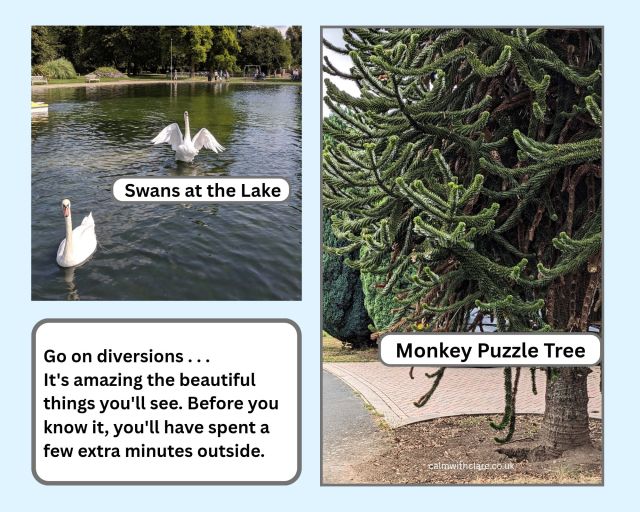
Once you have created the freedom and space for your goal you can then get creative and think of small ways that you can spend more time outside each day.
When pursuing my goal, I was reminded that when my son was a toddler we found reasons to go on diversions while we were out on errands in the local area.
For example, on the way back from the shop or the Post Office we might turn off to walk via the local Bus Stop and pause to watch some buses go by.
Alternatively, we might take a different route and walk via a housing estate where one of the houses had a large Monkey Puzzle tree on the front lawn. We would stop and admire the tree’s intricate branches.
At other times we might go to the lake at the local park to see the swans and the ducks.
Sometimes we would deliberately split up errands to complete over two days, instead of doing them all at once. This gave us a reason to go outside each day.
As my son grew older and I started to do errands by myself, I stopped taking these diversions and instead chose to take the quickest, most direct route to the shop.
I stopped giving myself permission to take the time to be curious and explore the points of interest on my journey to and from the shop.
I would encourage you to start taking these diversions. Be curious like a child and allow yourself an extra few minutes to intentionally take a different route to the shop or the bus stop.
Switching your routes regularly will make your life feel more interesting and less monotonous. With very little extra effort or time, you will naturally start to spend just a little bit more time outside.
It feels good to pause, notice the things around you and see the wonder in the world.
Just because we are adults, it does not mean we have to rush everywhere or simply carry out our tasks as quickly as possible.
If you intentionally seek out new sights and sounds, it is amazing the beautiful things you will notice in your surroundings.
Before you know it, you will have spent an extra few minutes outside.
It would be great to see your comments sharing what you have discovered in your local area while taking a quick diversion.
Celebrate Your Achievements
From my own experience, I can say that trying out some of these very simple changes is all it takes to start building the habit of becoming a person who spends more time outside.
As you try these simple activities, celebrate your wins and reflect with gratitude on any new experiences in nature or social interactions you enjoy as a result of stepping outside more often.
Below, I have included some suggestions about how you can celebrate your progress. Hopefully, these ideas will help you to feel motivated and inspired as you begin to develop your new habit.
Make lists of walks and routes
Record and make lists of walks and routes you have taken outside that you have particularly enjoyed.
For future reference, you can also make an additional note of the amount of time a particular walk or route took to complete.
For example, Keep a list of your favourite new routes to take when going to the local shop or Bus Stop.
Alternatively, make a list of a variety of quick walks you can take around the block or near to your house.
Browsing these lists can be an enjoyable celebration in itself.
On days when you find yourself lacking in enthusiasm for going outside, you can find motivation by looking at your lists and picking an appealing route to try.
Take photographs and create a photo nature journal
Take some photos of the inspiring and interesting things you see in nature while you are outside.
Create an album on your phone to collate your photos for future reference.
Perhaps call the album “My Nature Journal” and browse the album whenever you wish to celebrate your memories of your time spent outside.
You can turn to this photo journal on occasions when you are looking for inspiration or a spark of motivation.
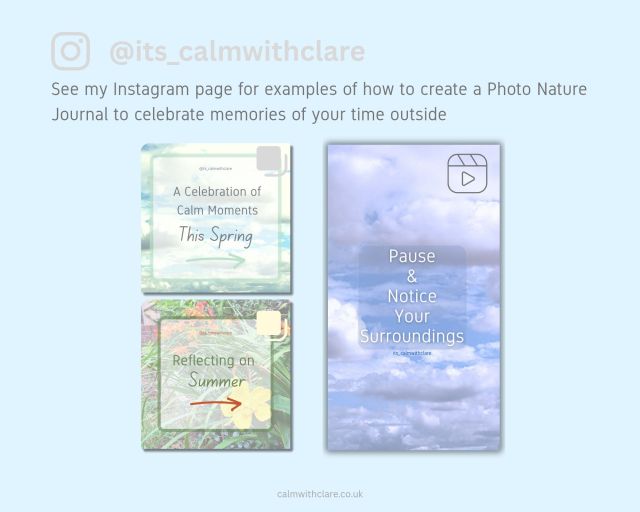
Click the Instagram Link below to view my carousel posts called “A Celebration of Calm Moments this Spring” and “Reflecting on Summer”. You can also watch my reel titled “Pause and Notice Your Surroundings”. These all provide examples of how you can collate and celebrate your memories of spending time outside in photographs.
Photo nature journals remind you that briefly pausing and noticing your surroundings, or being curious about all the things you can see around you is worth it.
They increase your awareness of the beauty you can see just by stepping outside.
For example, my Instagram Post called “Reflections on Summer” includes photographs that I took while shopping for school uniform with my son during the Summer Holidays.
Collating these photographs reminded me that you don’t need to go on an expensive day trip or holiday abroad to gain new experiences, spend time outside or enjoy nature during the summer season.
Simply making time for some minor diversions and noticing points of interest as you navigate your daily tasks can enrich each day and your whole life.
Creating photo nature journals, and returning to view them regularly, will help you to enjoy your simple, calm and positive memories.
Write in your journal about your time outside
If you prefer, you can write some short journal entries about your positive memories of spending time outside.
For example, you can write about how going outside made you feel on a particular day. Did you feel energised? Did you feel more connected to your community? Did it renew your enthusiasm for your home town?
Write it down so you can refer to it when you need motivation and encouragement at a later date.
Alternatively, you can create a scrapbook style journal and record your thoughts and memories of your time outside using a mixture of photos, illustrations and writing.
These celebratory lists, photographs and journals will remind you how far you have come and will hopefully provide motivation for you to continue with your new habit.
Missing a Day
Even with this simple aim, I urge you not to be a perfectionist with your goal of consistency. You will miss some days, it is inevitable.
We can define consistency as a habit you do more often than not and a habit you can easily return to if you miss a day along the way.
If you are too perfectionistic about keeping your daily streak, you will simply give up and feel like a failure as soon as you miss a day.
You are much more likely to succeed at engraining this new habit for life if you accept from the outset that you will miss some days. Therefore, you need to promise yourself that you will not call yourself a failure when you do.
You need to ensure that you don’t make “missing a day” mean something negative about yourself. Instead you need to promise yourself you will simply return to the habit the next day without judging yourself.
Having a plan in place for those days when you can’t make it outside, will deter you from falling into the perfectionist trap when it comes to consistency.
If you have such a plan, missing some days becomes part of the design of your new habit.
It is for that reason that my next blog post will cover how you can essentially “bring the outdoors in”. It will help you make a plan to create a calm day at home when you need to stay inside.
If this interests you, keep an eye out for my next post.
Motivation and Accountability
Celebrating your wins by making lists, taking photographs and journaling can provide very useful motivation to continue with your habit.
However, if like me, you find you need some kind of bigger external motivation or an external method to hold you accountable, you will wish to read this section.
When creating your new habit, it is important to consider what will continue to motivate you and hold you accountable once the initial spark of enthusiasm fades.
This is especially important with this particular habit of going outside, because this is a habit that requires you to do something extra that is not essential for work, school, or for others.
I have come to understand that I am much more likely to keep promises and stick at things if I have some form of external accountability.
If I know that what I am doing affects others or I am aware that other people, organisations or society in general have expectations of me in relation to a particular habit or task, I am much more likely to stick with it consistently or complete it.
Therefore, If I believe that I am the only person who will benefit from doing something and that no other person will ever find out if I don’t do it, I find it hard to hold myself personally accountable for sticking with a habit or completing a task. My motivation can waver greatly or completely disappear!!
For some reason, I quite often fail to keep promises to myself and let myself down, but I work very hard not to let others down.
There have been times when I have not found it easy to remain consistent with the habit of going outside, so I have needed many and varied ideas to spur me on.
I’m sure I am not alone in this struggle for motivation and accountability in relation to personal habits. I believe this is quite a common issue that many people face.
Therefore, below I have collated a variety of ways I have found useful to hold me externally accountable. They are ideas I have used to provide the motivation I need to achieve consistency with the habit of regularly going outside.
I hope you find these ideas useful during the inevitable ups and downs of pursuing your habit of going outside more regularly.
Motivational Reminder: Spending Time Outside Benefits Society
It can be very motivating to remind yourself that by spending time outside regularly you are making a positive contribution to society in a number of ways.
For example, you are taking individual action to improve your own health and wellbeing. You are therefore making a contribution towards protecting the valuable resources of the National Health Service (NHS) and helping to build a healthier population overall.
Also, by venturing outside and choosing to spend time away from the technical devices and screens that would normally take you away from the natural and physical world, you are reducing your chances of you becoming isolated and lonely.
You are more likely to socialise and contribute to a vibrant and safe community and society.
Increasingly, we as a society are coming to an understanding that real life social interactions can protect an individual’s health and wellbeing and help to create a more cohesive community and a healthier society in general.
You might think it sounds like a bit of a dramatic claim, but I believe that by practicing the habit of spending more time outside you are making a positive societal contribution.
Regularly reminding yourself of these societal benefits can act as a strong motivating factor as you try to hold yourself accountable for maintaining the habit of going outside.
Below I have provided a more detailed discussion of these benefits which should provide you with more than enough information to convince you that these societal benefits are impactful and real and that pursuing your habit is extremely worthwhile.
Societal Benefit Number 1: Protecting the National Health Service (NHS) and contributing to the general health and wellbeing of the population
Since the new Government was elected in the UK in 2024 they have promoted the principles they will work by to enable the UK to have a “healthy population” and a “thriving society”.
There have been many reports in the media about the importance of proactively looking after our nation’s health to ensure we can all live well into old age, while also protecting the NHS as we go forward into the future with an aging population.
In his Speech at the Labour Party Conference 2024 , Wes Streeting (who was Health Secretary at the time) set out the key aspects of the Government’s approach to health, by outlining two important principles for a proactive approach to health care:
- Shifting the focus from “sickness to prevention”.
- Moving the majority of resources and care from “hospital to community”.
See full references for the transcript of this 2024 Conference Speech detailed at the end of this post.
The aim is to keep the nation’s population well and healthy. The Government hope to keep more people out of hospital by supporting their health within their own neighbouthoods.
It is claimed this shift should protect NHS hospital resources, reduce waiting lists and ensure plenty of hospital care is available to everyone who really needs it, when they need it .
Within this holistic approach, the Government believes both communities and individuals can proactively play their part.
The NHS and other national and local government departments all have an important role to play to ensure that suitable care, housing, work and education are available to the whole population.
The Government also wish to encourage individuals to feel more empowered to make choices and decisions for themselves.
When considering the Government’s approach, I found it motivating to think about the many ways that we can all play our part in our day-to-day lives to try to live healthily and, in turn, support the Government in its efforts to develop supportive communities and a modern, proactive NHS.
We can all take steps that will help the population as a whole to remain as healthy as possible. One important step each of us can take is to spend more time outside.
It may seem like a very small simple thing, but it all adds up. Your one small simple shift towards spending more time outside can have a much bigger impact on your own health and the health and protection of your local community and wider society than you might at first think.
I have read a number of self-help books that are all in agreement that going outside (even for only short periods of time) and experiencing natural daylight, nature and mixing with others all have benefits to our wellbeing.
I have read enough to convince myself that spending time outside is beneficial to health and wellbeing.
I believe that looking after myself and supporting my health and wellbeing, while modelling for my son this healthy habit of enjoying being outside is far from a purely selfish act.
I am supporting my own and my family’s health, while also being present outside so that the community does not feel deserted or threatening. I may encourage others (even strangers who I do not know) to venture outside.
I am making a contribution towards creating the kind of healthy and happy local community and society I wish to belong to.
Knowing that I am having a societal impact outside of myself is a very motivating idea that I can draw upon to hold myself accountable when I doubt myself, or worry my new habit takes up too much time when there are more important things to do, or feel like my new habit is “not important”.
At these times, I can put things into perspective by asking myself, “What can be more important than making your own personal contribution towards the health and wellbeing of your local community and society in general?“
I hope you will find this wider societal benefit a motivating idea that will help you to hold yourself accountable too.
You may live outside of the UK, but wherever you’re based, I’m sure discussions about addressing overwhelmed or difficult-to-access health care systems and the need to make plans for future aging populations are very familiar to you.
Wherever you live, I’m sure you can resonate with these societal issues and use them as motivating factors to hold yourself accountable when developing your habit of spending time outdoors.
Societal Benefit Number 2: Countering the Negative Impacts of Modern Technology on our Health and Wellbeing
In the Media, you can find regular discussions and articles published about the importance of countering the negative impacts that modern technology can have on our health and wellbeing.
Such discussions highlight the importance going into nature and socialising in person with our friends, work colleagues and family.
You can’t have escaped the multiple discussions that have taken place over the last few years about how many of us spend too much time indoors and how this can have an impact on our sleep patterns and general wellbeing.
There are concerns that we spend too much time alone using our screens, rather than going out into the real and natural world and instead of socialising with others.
There appear to be particular concerns about how the focus of our work and the static nature of our hobbies and routines in the modern technical world are affecting the younger generation.
It seems our children are less likely to spend time out socialising with their friends than our generation when we were young.
There are concerns that this may be affecting their mental wellbeing and there are theories that it could, possibly, be contributing to elevated levels of social anxiety among this generation.
For more details about this topic, you can use the full reference at end of this post to view a Youtube video discussion on BBC Global about the potential impact of decreased socialising among young people and what can be done about it.
For the reasons listed above, it seems in our modern world we are all becoming increasingly aware that spending time outside and creating the chance to meet up in person with other people is a very important part of looking after ourselves.
Spending time outside provides a two-pronged benefit. Firstly, the social element of mixing with other people and, secondly the health and mental wellbeing benefits of interacting with nature.
It has become extremely clear from reading around this topic that simply spending more time outside can offer us a wide range of important benefits that go far beyond physical exercise or getting enough vitamin D!! There are many other far-reaching benefits.
If you would like to dive more deeply into the particular benefits of spending time in nature, please use the reference at the end of this post to listen to two episodes on the “What’s Up Docs?” podcast which contain a detailed discussion of this topic.
It’s quite amazing to think that just stepping outside the front door can be so beneficial.
For example, you might find yourself socialising by having a chat with a neighbour or you may walk past someone from the local community walking their dog and say “hello”.
Alternatively, you may find yourself using all your senses as you interact with nature by looking up into the blue sky where birds are flying, feeling the twigs crunch beneath your feet as you walk among green trees, hearing the grasshoppers in the long grass, smelling the scent of flowers and pine trees, or simply breathing in the fresh outside air.
The combination of socialising with other people and experiencing the natural world using all of your senses can have a very positive impact, even if you are only outside briefly.
The benefits will not only rest with you, you will be having a positive benefit on the other people you meet too.
Your neighbour will benefit from the chat you had and the dog walker too.
The more of us from all different ages and backgrounds who spend time out-and-about in our communities, the more welcoming, safe and appealing those communities will become to a wider variety of people. This can only be a positive thing.
In addition, passing onto our children the joys and importance of the outdoors and socialising with other people seems to be something very important to focus on right now, if not essential.
I cannot think of any better motivation, or a more impactful reason, for us all to hold ourselves accountable when developing this new habit of going outdoors regularly.
If you would like to begin your own more detailed research into the possible benefits to your wellbeing of going outside, please see the list of references at the end of this post. In the reference section I include some further detail about the types of benefits identified by the books I have read.
IMPORTANT: Please bear in mind, I am not a medical expert, so if you have specific medical concerns about your own health or have further questions about the relationship between spending time outside and your health and wellbeing, you should seek your own advice from your own GP or another qualified medical practitioner. I am not qualified to discuss medical issues in detail on this blog.
On this blog, I will not delve any deeper into these discussions about the medical, wellbeing and social benefits for human beings of interacting socially within the natural and physical world outside.
Many experts exist who are much more qualified to discuss these matters than me!
I hope the overview that I have provided here is sufficient to persuade you that having an awareness of these issues (and of how spending time outside can help to address them) can be a very good source of motivation for us all when trying to develop our own habits.
By proactively seeking out opportunities to spend more time outside, each individual can play their part in helping to reduce loneliness and improve the health and wellbeing of the population within our local communities and society as a whole.
We can also raise our children so that they are aware of the importance of connection with the natural world and the benefits of socialising, in person, with their own friends within their own physical local community.
I hope you find these reminders of the societal benefits of your actions and habits a strong source of motivation and accountability for you.
Other Sources of Inspiration
If you are looking for something a bit different to inspire you, this section could be for you (especially if you are a keen reader).
For an extra boost, I found it useful to seek out sources of inspiration beyond the facts and figures of government policy and non-fiction resource books.
I realised that I have read many different categories of books that mention the importance of spending time outside.
I revisited some of these books that focus on the positive effects of being outside.
I found that emersing myself in the ideas contained in some of my favourite fiction and non-fiction books gave me real enthusiasm for continuing on with my habit.
I share them here in the hope that you feel the same.
Childrens’ Fiction – Favourite Stories and Characters from my Childhood
Some of my favourite Children’s Classical Fiction books clearly promote and nurture the idea that spending time outside is very important to the wellbeing and happiness of the main characters.
This shows that the belief that it is important for children to socialise with their peers and spend time outside is far from a new idea. The books I refer to below were all written between 1880 and 1911. So, these ideas have been shared and discussed for a very long time!
Heidi (by Johanna Spyri), The Secret Garden (by Frances Hodgson) and Anne of Green Gables (by L.M. Montgomery) all explore this theme.
Please be aware, If you have not read these books and are not familiar with the stories, this section may contain some spoilers.
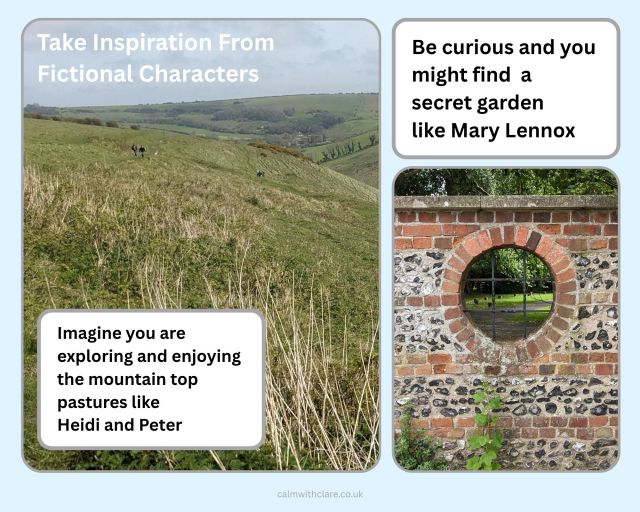
Heidi lives with her Grandfather in the Swiss Alps. She enjoys regular walks with her good friend Peter (and his goats).
Their walks take them high up into the mountains where they spend many hours each day exploring pastures filled with wild flowers. Heidi thrives. She is healthy, happy and contented.
Much to her disappointment, she is moved to the town to be the live-in companion of a young girl called Clara. Heidi becomes less vital, low in mood and homesick. She longs to return to her life in the Alps.
Clara, has lived an isolated life indoors. Those who care for her are very protective of her due to an illness she suffers which has affected her mobility so that she is reliant on a wheelchair.
Clara enjoys Heidi’s company and the stories and descriptions she shares about her adventures with her friends in the Alps.
Clara visits Heidi in the Alps and spends more time outside in the fresh air. Heidi, Peter and Clara all laugh and play together. Clara too thrives and becomes happier whilst spending time outside in the Alps.
Similarly, The Secret Garden explores themes which are overtly and symbolically about the healing properties of a garden in bloom.
When Mary Lennox moves to her uncles house, there is a walled garden that is kept locked up and is a secret.
All the residents at the big house are tense and unhappy including the main character Mary. On arrival at the house Mary is very miserable and is stuck inside.
One day a kind servant gives Mary a skipping rope and tells her to go outside and play in the grounds.
As she skips around the grounds of the big house, Mary starts to talk to the gardener and makes friends with a robin that bobs about nearby to the gardener. She also meets and becomes friends with Dickon, the brother of the kind servant.
Once she starts spending time outside and socialising with a variety of people around her, she becomes happier and a more pleasant person to be around.
One day, Mary finds the secret garden locked away. She also discovers that she has a cousin who is also living at the house and is unwell. He is kept inside the house in a darkened room surrounded by servants who care for him to protect him from germs and keep him safe. Mary and her cousin become friends.
After Mary discovers the secret garden the book describes how the garden and nature play a pivotal role in healing all the characters in the book in many and varied ways. The garden helps to heal the relationships between the people of the house too.
Both books strongly promote the idea that allowing children the freedom to spend time with their friends and explore nature is good for both their physical health and general wellbeing.
The books paint an idealic picture of growing up in a natural environment, showing it to be life-giving for young people. On the contrary, they describe a life spent lonely and indoors as draining, dull and stifling.
Anne of Green Gables explores similar themes. When Anne arrives at Green Gables she is enthralled by its beauty and stares in wonder at all of the nature around her as she explores Prince Edward Island.
Anne’s surroundings feed her imagination. She names all of her favourite locations with elaborate romanticised names.
For example she is told the real name of a place is “the Avenue”. Anne renames it the “White Way of Delight” because she thinks it is a more imaginative name.
When Anne sees the place called “Barry’s Pond”, she does not like that name either. She chooses to call it the “Lake of Shining Waters”.
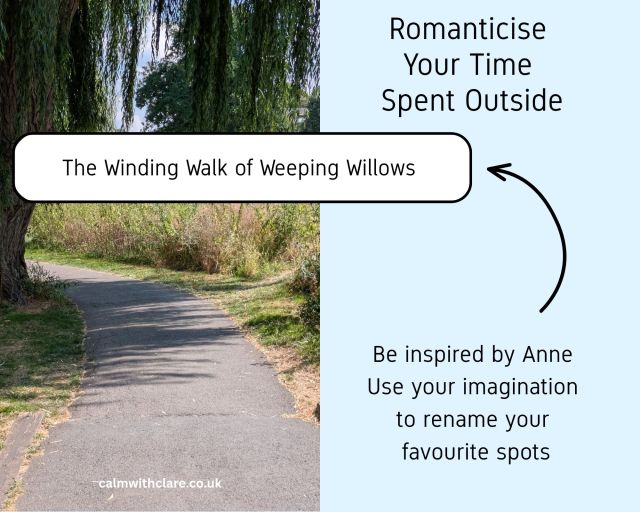
Anne thrives as she explores her surroundings with her “bossom friend” Diana and she uses every opportunity to go outside into nature and to generally soak it all up using all of her senses.
Anne is seeing the Island with fresh eyes. When she shares her enthusiasm for all she sees with the residents who have lived on Prince Edward Island for all their lives, she inspires them to live better, more appreciative lives too.
Reminding myself of these wonderful and uplifting stories that I so much enjoyed reading as a child, has encouraged me to be inspired by Heidi, Mary and Anne.
I now choose to romanticise the idea of spending time outside in my local community too. I choose to use all my senses to seek out the beauty and wonder in my surroundings.
I try to use my imagination, like Anne, and rename the places around me with more romanticised names. I think, “what would Anne call this place?” and try to choose a name that better fits its true beauty or a name that truelly describes how the place makes me feel.
These classic stories really motivate me to prioritise the habit of going outside consistently. I would recommend each of them to you if you need some uplifting motivation.
Let me know in the comments which of your favourite fiction books from your childhood help you feel inspired to go outside. I would love to discover some more titles to add to my motivational list of fiction books.
Non-Fiction – Inspiration from Autobographical Storytelling
Non-fiction books about real peoples’ lives can provide similar inspiration.
I recommend the following non-fiction, autobiographical book. It’s called “Monty and Sarah Don, The Jewel Garden A Story of Despair and Redemption”.
This book describes how Monty and Sarah moved away from a career that Monty found stressful and that was affecting his mental health. They relocated to a house where they built a garden that they called the Jewel Garden (their old business related to jewellery).
Monty found that working and spending time out in the garden throughout all the different seasons of the year was extremely supportive of his mental health.
In the book Monty Don (likely known by many in the UK as the Gardener from Gardeners World on BBC television) describes the importance, if not the absolute necessity, for him to spend time exercising and gardening outside to help him heal from and manage his depression.
I found the book extremely moving and inspiring.
Having read it, I distinctly remember one Autumn after a particularly long and tough week at work, I felt inspired to get up early on a Saturday morning. I went outside in the chilly morning light and air.
I swept the leaves that had fallen from the oak tree overhanging our garden. It certainly did feel good to take some deep breaths, do something active and clear my mind of all the thoughts from the working week.
I like to remind myself of this on days when I feel too busy or do not fancy going outside. It encourages me to get out into the fresh air.
I would also recommend a book I read more recently called “Bill Bailey’s Remarkable Guide To Happiness”.
This is a great book to dip into for some short inspirational reading on many varied and interesting topics. Bill’s writing will put a smile on your face.
As I am sure many of you will already know, Bill Bailey is better known as a comedian so his writing definitely makes you smile.
It is no coincidence that in a book about happiness, a number of his chapters focus on spending time outside or spending time with nature. There are chapters called Caring for Plants, Trees, Birdsong, Walking and Being in Nature.
I hope you too feel encouraged to go outside, even when you don’t really feel like it. You are bound to feel better afterwards.
Can you recommend any non-fiction books that have inspired you to step outside? If so, please share them in the comments. They might be helpful to other readers of this blog who are seeking a spark of motivation.
I hope I have succeeded in my aim to persuade you that you can create the habit of going outside regularly and that it is worth the effort to do so, not only for yourself but for society as a whole too.
I hope the many and varied thoughts, ideas and practical examples I have shared here will help you to remain consistent with your habit for long enough that it becomes a part of your identity in the same way as something simple you do everyday – such as brushing your teeth!
Remember to look out for my next post about “bringing the outdoors in”, to make a plan for those days when you genuinely can’t go outside.
Until then, enjoy your time spent outside.
Thanks for reading.
Clare
Recommended Resources For Further Research
General
Conference Speeches – Wes Streeting’s Speech at The Labour Party Conference 2024 | labour.org.uk (Use websites search bar to find the transcript of Streeting’s Speech). You may also be interested to read the 2024 speech transcripts of Angela Raynor (Secretary of State for Housing, Communities and Local Government); Liz Kendall (Secretary of State for Work and Pensions); and Bridget Phillipson(Secretary of State for Education).
YouTube Video – People Are Partying Less. Here’s Why That’s Worrying | BBC Global (@BBC_Global). A discussion about why young people are socialising less and the negative impact this appears to be having on their wellbeing.
Podcast – BBC Radio 4 | What’s Up Doc?| With Drs Chris and Xand van Tulleken, episode 58 (Is nature good for you?) and episide 59 (Doctors’ Notes: Nature).
Books
Why We Sleep – The New Science of Sleep and Dreams, by Mathew Walker, Penguin 2018 (originally published 2017) – References Circadian Rhythms, pp 17-19
The Clever Guts Diet, How to revolutionise your body from the inside out, by Dr Michael Mosely, Short Books 2017 -References the importance of bright early morning light for good sleep (p173), and discusses the benefits of fresh outdoor air and activities that connect you with nature (especially the soil), such as gardening (p69)
Marie Kondo’s Kurashi at Home – How to organise your space and achieve your ideal life, by Marie Kondo, Bluebird 2022 – references how she and her husband go for daily walks together to integrate exercise into their routine in an enjoyable way, while walking they check in with each other (“Movement Helps your Energy Flow” p159).
Why Has Nobody Told Me This Before? by Dr Julie Smith, Penguin 2022 – references the connection between exercise and sensitivity to finding joy in your life. Highlights the particular benefits of exercising in green spaces instead of on a treadmill indoors (p55-56).
Heidi, by Johanna Spyri (First published between 1880 and 1881)
The Secret Garden, by Frances Hodgson (First Published 1911)
Anne of Green Gables, by L. M. Montgomery, First Published 1908, Puffin Books, this edition 2010 – The examples included above of Anne renaming her favourite places with new romanticised names were taken from Chapter 2 (pp 26-27)
The Jewel Garden, A story of Despair and Redemption, by Monty and Sarah Don, Hodder and Stoughton 2005 – references the importance of spending time outside in the garden and contact with the soil (pp 19-20)
Bill Bailey’s Remarkable Guide To Happiness – by Bill Baily, Quercus 2020, see page 1 for the Table of Contents showing the chapter names referring to nature.
IMPORTANT REMINDER: You should always consult a medical professional for advice if you have any medical concerns about your physical or mental health. I do not have any medical qualifications or expertise. I have written this post and created my blog based purely on my own reading and personal experiences. And I hope to provide some inspiration and promote some discussion about the topics I cover. I share my writing purely for entertainment purposes only.
Follow Me on Instagram
(You’ll find me @its_calmwithclare)
Click the Instagram link below to visit My Profile page and discover Posts, Reels and Stories about all things calm. I generally post each week on themes relating to the “Featured Post” on this blog*.
Follow Me on Pinterest
(You’ll find me @calmwithclare)
For more inspiration about habits and spending more time outside, click the Pinterest link below and take a look at my saved Pinterest Boards “Calm and Good Habits”, “Special Occasions” and “Happy and Calm”.
I would love for you to join me on Instagram and Pinterest.
*Please visit this blog’s About page to find details of this week’s featured post.

Visit the About page now for Free Printable
© 2019 – 2026 Clare | Calm with Clare | Creating Calm with Clare. All Rights Reserved.

