

Calm Parent – Calm Child
“The Wisdom of Life Consists in the Elimination of Non-essentials”
– Lin Yutang
(As quoted by Greg McKeown at the beginning of chapter 1 of his book Essentialism, The Disciplined Pursuit of Less)
Please Note This post was originally posted in 2022 as part of a two-part series. Minor edits were made to this post in April 2024 to reflect the fact that the series has now been re-blogged as a six-part series to ensure ease of reference for readers.
Does your young child find the idea of doing homework extremely upsetting and challenging?
As a parent, does helping your young child with homework fill you with dread and fear?
Do homework sessions often end in tears, upset, arguments, and family tension?
Do you find yourself wishing your child did not have to do any homework or find yourself blaming the school for sending home inappropriate homework tasks?
If you have answered yes to any of these questions, you may wish to read on.
When my son’s school first began setting him homework, as he settled into Reception Class at Primary School (aged 4), we as a family had to grapple with the difficulties, overwhelming feelings and experiences alluded to in the questions I have listed above.
Sometimes, attempting to do homework felt like such a negative and stressful experience for my son and our family that it seemed it might be better not to do the homework at all !!
After a number of weeks of unsatisfactory homework experiences, it soon became clear that we needed a new approach to homework for our son.
If you have reached the stage where you feel like you just want to tear up your child’s homework instructions, run away and bury your head in the sand, believe me, you are not alone. I hope you may find something useful included in this blog series to help you on your way to a more positive homework experience for both you and your child.
In this post (Part 1), I will be concentrating on discussing how you can gain an overview of overriding issues that may have gone unnoticed and may be hindering your chances of enjoying calm homework sessions with your young child. I will describe how we have created a good homework culture in our home. I will then invite you to consider what a good homework culture would look like for your family.
The remainder of the posts in this series (parts 2-6) will be more practical and specific. In parts 2-6, I will be taking you through some ideas for practical steps you can take to help your child calmly complete individual pieces of homework.
For ease of reference, here is a summary of the 10 practical ideas that I discuss throughout parts 2-6 of this series along with links to each part (If you prefer, you can scroll past this “Overview Section” and skip straight to this post’s topic which focuses on creating a good homework culture in your home):-
Summary of the 10 Practical Ideas We Will Discuss in Parts 2-6 of this Series
- Familiarise yourself with the school’s expectations for homework (Part 2).
- Identify the best time of day and the best days each week to do homework with your child (Part 3).
- Prepare your home environment for each homework session (Part 3).
- Mentally prepare yourself for each homework session (Part 4).
- Reduce anxiety by separating the process of choosing which task to do from actually completing the task (Part 4).
- Be clear as to whether the task is “Time Limited” or “Task Limited” (Part 5).
- Identify your child’s favourite subjects and their preferred learning style. Use your knowledge of their preferences to your advantage when approaching homework (Part 5).
- Identify the underlying learning purpose (or learning objective) behind the task and be clear about what the teacher wants your child to learn before starting the task (Part 5).
- If you think it will be helpful to prepare some modified resources to help your child complete their homework more independently, get those resources organised before you and your child sit down at the homework table (Part 6).
- Use your imagination to make things more fun, if necessary, by completing the homework in an innovative way (Part 6).
Our Family’s Homework Story
Our son is considered academically capable and at school, he is seen as a student who enjoys his learning. Consequently, there is an assumption that he will enjoy continuing his learning at home and thrive on engaging in extra learning activities away from school. In the early years, what sometimes seemed to go unnoticed, was the toil the school day took upon our young son.
Our son found a full day in the school environment draining and he would use up all his goodwill and energy throughout the school day itself; putting on a smile and a brave face and trying to please his teachers. He also often worried about school in the evenings and this affected his sleep.
In these circumstances, he found each school day and each school week a severe imposition on his time and life. The school routine had a large impact on his mental energy stores.
He was, therefore, not the kind of young person who would come running home enthusiastic to do his homework. When the school day, school week or school term was over, he had had enough!
He wanted to leave it all behind at the school gate and was desperate for the freedom to relax, get on with his own thing and recharge his batteries before it was time to return to school, all too soon, to do it all over again.
Adding homework into the mix was never going to be a popular addition to his life and we as a family needed to recognise and accept that. We had to find ways to try and reduce the toil that the school routine took upon him and help him to accept the sheer fact of the existence of homework and to learn to enjoy (or at least to put up with!!) the process of completing homework as much as possible.
I have no particular expertise or qualifications in childhood education or the theories of home learning. I am, however, lucky enough to have a Dad who was an English teacher and a Special Needs Co-ordinator in a Secondary School before he retired. I am extremely grateful I was able to rely on his experience and talk to him about this topic.
Nonetheless, as I summarise the ideas and approaches we have found useful below, I want to clearly emphasise that all I share below comes purely from my personal experiences as a Mum, I am certainly not claiming to be an expert in this field.
It has taken lots of time and effort from my Fiance and myself. There have been lots of discussions with my Dad and much trial and error. However, we have now established, what I would consider to be, a good homework culture for our son and our family. It is certainly not perfect and we sometimes have “wobbles” (some worse than others!!) but generally speaking homework now goes more smoothly for our son (and our family as a whole).
I am looking forward to sharing with you the specific details of the “good homework culture” we have created in our home.
However, before that, I think it is important to consider some overriding general considerations that can unknowingly impact homework sessions with our children.
I would like to begin by highlighting the following Very Important Reminder:-
It’s NOT Your Homework, it’s Your Child’s Homework
The School sets homework to be completed by a certain date and, we as parents, seem to feel duty-bound to ensure it is completed on time, as set, regardless of the consequences to family life or our child’s wellbeing.
Before my son started school, I had never really thought about what I would do, or how I would feel if my son did not wish to complete his homework.
In my own personal life, I have always been a strict rule follower. I was the kind of student who some would probably describe as a “teacher’s pet” or a “goody two-shoes”. Despite a serious problem with procrastination, I would “burn the midnight oil” to meet any deadline and complete any task set to the best of my ability, with the aim to please my teachers.
When my son appeared not to be so keen to comply with such a regime, I have to admit I found it uncomfortable and difficult to cope with. I still wanted to “please the teachers” and ensure my son handed in carefully completed homework on time. The fear of not being able to do so filled ME with the anxiety that I would be found wanting as a parent and the teachers would not be pleased with me and my son!!
I had to grapple with my own feelings and come to realise that:
” The homework set was not my homework, it was my son’s!! “
I had to allow my son to be his own person and become his own kind of student and learn to complete his own homework in his own way.
Accepting this realisation was an important starting point. We as parents have all been school students in the past. Therefore, I think without realising it, we will all approach homework with our own expectations and baggage.
It is important to recognise that when we as parents set out on our homework journey with our children, some beliefs, expectations and baggage that we may carry from our own youth and school days may not be useful when trying to help our children with their homework.
Sometimes it is our own beliefs, expectations and baggage that are partly causing the tension, arguments and upset. It’s important to realise that difficult homework sessions do not only come down to your child’s attitudes, hang-ups and behaviours. You as the parent can bring your own insecurities, engrained unhelpful beliefs, conflict and difficulties to the homework table too.
So, before sitting down with your child to do any homework, I think it is important to pause and analyse your own experiences of homework, your own expectations, your own strengths and weaknesses and your own fears. This can be helpful in identifying some of the reasons why completing homework with your child can become turbulent.
If you have a partner, or if there are other adults who are also going to be involved in setting expectations for homework or helping with homework you will need to consider their thoughts, hang-ups and approaches to homework too. When you approach your child to do homework, it is important that there is no conflict between the adults involved because such conflict will only show up as more stress during homework sessions.
Any friction between the adults about homework should be resolved before setting out on the homework journey with your child. Otherwise, your young child will pick up on any feelings of conflict and this will only add to their anxiety and confusion about the homework process.
Identifying and Understanding Helpful and Unhelpful Mindsets (Of Both Parents and Children) when approaching Homework and Learning
Identifying, and gaining an understanding of, the underlying mindsets of all those involved in the homework sessions (both parents and children) can be extremely helpful and informative. Delving into these issues can shine a light on why certain behaviours are exhibited and why tensions arise between parents and children. Understanding these underlying thought patterns can signpost you clearly in the right direction towards making things better for the future.
When I studied our family’s mindsets in relation to homework, I realised that I identify as a perfectionist and can be described as a “people-pleaser”.
I have gradually come to realise that my son appears to demonstrate perfectionist tendencies too and also shows signs of being a “people-pleaser”.
However, despite displaying similar traits (which you might think would make us ideal homework partners) our approaches to coping with our perfectionist tendencies and “people-pleasing” are very different. Therefore, our approaches to dealing with the need to complete homework tasks are completely different too!!
My approach to dealing with perfectionism and “people-pleasing” is to employ the delaying tactic of “procrastination”. My particular form of procrastination takes the form of over-planning, over-thinking, over-researching, constant checking with others as to whether my approach is right and trying to second-guess exactly what the teacher hopes to receive as the perfect piece of homework. This leads to lengthy homework sessions, spending lots of time and emotional energy (right up until the deadline) creating elaborate, carefully produced pieces of work. This is all done so that I can be as confident as possible that I am handing in a piece of homework that looks like it has taken a great deal of time and effort. A piece of work that the teacher will, hopefully, be very pleased with.
Looking back at my school career I have to accept that my own procrastination, perfectionist tendencies and people-pleasing attempts were quite destructive to my own emotional wellbeing during my studies.
However, this is a realisation I have only just come to. Until very recently I was living under the misconception that perfectionism and people-pleasing were good personality traits that enabled me to create good quality work. I have now come to an understanding that they were in fact the central cause of my worry, procrastination, erratic study patterns and stress throughout my studies (and indeed my work life).
Perfectionism and People-Pleasing showed up in a very different way for my son. Initially, I did not understand that he was coming from a place of perfectionism and people-pleasing. At the time, I was still in a place where I thought such tendencies led people to create high-quality, carefully completed work.
Back then, I just thought my son was “acting-up” because he simply did not want to waste his time doing school work at home or that he was incapable of sitting still to do homework. This led to lots of tension and upset between us at homework sessions. I thought he was being fidgety, obstructive, or simply not trying. This led to arguments between us.
In fact, what was happening was that my son’s perfectionism was showing up as complete avoidance of any tasks that he believed he could not do or was not good at. He might sit fiddling with pencil sharpeners, wobbling on his chair, or he might keep leaving the table to do something “very important” in another room. All of this was done to completely avoid doing the task he felt he could not do perfectly and that he was afraid of failing at.
For example, when he was learning to do handwriting and he could still only write slowly in big letters and quite messily, he believed he was rubbish at handwriting. He would either refuse to write at all or he would scribble all over his work deliberately ruining his work rather than risking trying for real.
Another example is, when colouring, he would not try to stay inside the lines, he would instead deliberately colour messily all over the page rather than risking trying to stay in the lines and failing.
His approach seemed to be that if he could not do something perfectly he would not risk trying to do it at all.
This was a real problem for us. As he was also a people-pleaser, he was not happy not to do the homework. He was also not content to hand in his deliberate “scribbles” or “messy” colouring because he knew it would not please his teacher.
Our son was stuck in an awful paradox of not wanting to commit any work to paper for fear of being less than perfect or labeled as a failure. However, he also worried about going to school if he had not completed his homework in a way that he felt would please his teacher. This contradictory combination of beliefs, thoughts and fears led to my son becoming very anxious, upset, emotional and sometimes angry, during homework sessions.
It was only after my son completed his very first spelling test at school that I fully came to realise the extent of his avoidance when he was anxious.
My son practised a list of words for the spelling test all week long. I knew he could spell all ten words correctly. However, when he sat the test he wrote absolutely nothing on the sheet of paper. During the test he did not attempt any of the words and handed in a blank sheet of paper to his teacher.
After the test, the teacher spoke to me about what had happened and seemed confused. When I spoke to my son about the test, he explained that he was worried about getting things wrong and disappointing his teacher if he made mistakes and that is why he had handed in a blank sheet of paper.
Once the teacher was made aware of this, the teacher spoke to my son and reassured him about the purpose of the test and explained to him that it was ok if he got some words wrong. The teacher explained they would not be upset or disappointed if there were some mistakes, they just needed to check which words he knew and which he did not. Having clarified this, the teacher let him sit the test again. He got 10 out of 10.
It was witnessing the destructive nature of perfectionism and people-pleasing and how it manifested itself in my son, along with researching how to help him overcome these difficulties, that allowed me to recognise the destructive nature of these thought patterns in my own life.
These mindset issues were at the root of the tensions for both of us when approaching homework. I came to realise my own engrained attitudes and fears were not at all helpful in this situation. Once I recognised this, I was able to adjust my own approach to the homework sessions.
I was able to recognise when my own unhelpful thoughts were in danger of de-railing the session and stop myself from communicating those thoughts to my son. I was also able to play a much more appropriate and supportive role in helping my son overcome his fears, perfectionism and people-pleasing tendencies whenever they arose during homework sessions. This adjustment alone immensely improved our homework sessions.
In your family the thought patterns of perfectionism and people-pleasing may not arise. However, there may be other thought patterns or unhelpful mindsets bubbling under the surface that are making homework difficult.
It is definitely worth thinking these things through to ensure you fully understand what is causing any disagreements or any difficult behaviours during homework sessions. Gaining this deeper understanding could be the key to calm homework sessions in the future.
How Much Homework To Do?
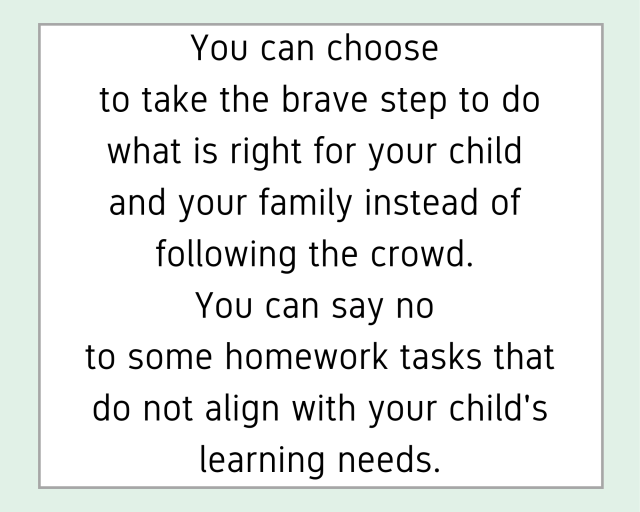
Just because it’s set doesn’t mean you have to do it all.
You do not need to join in every activity or project that is suggested for completion at home. Some homework will be core tasks. Others will be for fun or voluntary. Some ideas that are sent home will simply be an invitation to learn and not compulsory.
As parents, we can feel very pressured to ensure that our children join in with all the activities and learning opportunities that are sent home from school. We can feel fearful that our child will be missing out or falling behind if they do not partake in every opportunity on offer.
It is important to try not to fear judgment if you do not do it all. For example, if your child does not want to design a Christmas card or join in the Easter Egg design contest, it is OK not to join in if the school has made it clear that these are opportunities that are offered for fun and you have a choice whether to join in or not.
There is always a danger of comparison among parents. This can lead you to put unnecessary pressure on your child, yourself and your family to join in every opportunity that is sent home, regardless of its appropriateness for your child’s interests, learning needs, or the needs of your family in general.
It can feel like a brave step to do what is right for your child and your family instead of joining in with the crowd. However, it is important to remember that every child is different. They all have different interests, learning styles, likes and dislikes. That is ok and is in fact something to be celebrated. It is the uniqueness of each human being that makes the world an interesting and varied place. By teaching and reassuring your child that it is OK to say no to requests and opportunities sometimes, you are also teaching them a very important skill for the future.
In summary, you and your child get to decide how much or how little homework your child will join in with. You may decide to only complete the compulsory core tasks and that’s ok. You may choose to only join in the voluntary extra activities if it matches one of your child’s core interests or if your child has had a particularly good week and has the capacity to complete something extra. That is OK too.
If the decisions you make about how much homework to complete align with the needs of your own child and your own family that is OK, even if your child’s classmate is completing every piece of homework sent home or your next-door neighbours’ child always likes to complete all of the extra fun tasks suggested.
It is not a competition between the children to see who can do the most homework. Each child is on their own individual learning journey and it is ok for them to travel their own journey at their own pace and in their own unique way.
Creating an Agreed Homework Culture in Your Home
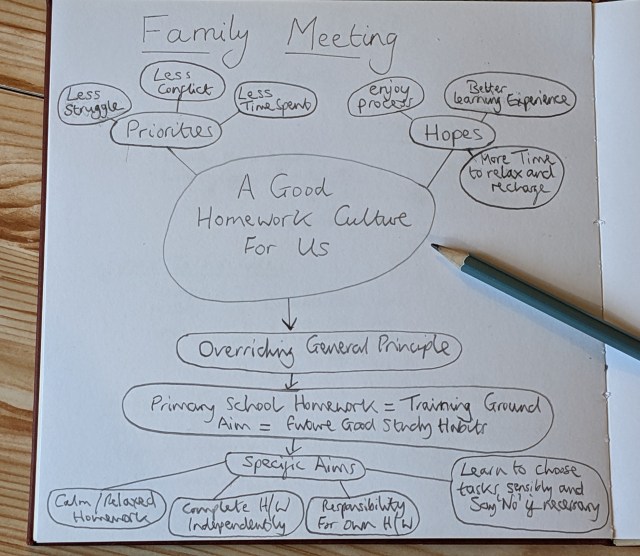
It is really important for everyone involved to have a unified approach to homework.
I believe that the best way to achieve this unified approach is for the adults to decide together what they would like the homework culture in their household to be.
When considering our approach, we put aside our own engrained thoughts and habits in relation to homework. We tried to ignore any feelings of societal or peer pressure to try and do it all. We simply took note of our son’s individual feelings and needs in relation to his homework.
We also considered what we had learned about the impact that mindset can have on both the parents and children when approaching homework. We tried to incorporate this and make allowances in our plan for the internal struggles that we might all face due to such thought patterns.
We concluded that we had a number of priorities in relation to homework.
- We did not want homework to be a big mountain that our son struggled to climb each week.
- We did not want homework to be a cause of conflict in the home.
- We did not want the process of completing homework to take up too much time and eat into the precious time our son had at home to recharge his batteries.
- We hoped that if we put some limits and structure around the way we tackled homework, our son would come to enjoy the process more.
- Ultimately, we hoped our structure would enable him to engage in a better quality learning experience rather than just focusing on the necessity to simply get it all done.
Having taken this all into account, we decided that in our home our homework culture would be based on the idea that homework set at Primary School is largely set to help children get into the habit of regularly undertaking some learning at home. We agreed that the aim of Primary School homework was to ensure that by the time children reach secondary school (and learning at home becomes more important) they are ready to fully engage with the process and take independent responsibility for it. Therefore, we decided that in our home we would approach homework under the following overriding general Principle: –
Primary School Homework is purely set to enable a “training ground” for future good study habits. Therefore, the outcome of individual pieces of homework is not the important marker for success. The aim is to encourage good habits, allow independent study and responsibility for tasks and generally cultivate a positive and relaxed approach to completing school work and learning within the home.
Having established our priorities and this overriding principle we were able to list the following more specific aims to work by: –
- Encourage our son to remain as calm and relaxed as possible while completing homework tasks. We aimed to teach him to enjoy the process of completing his work as much as possible (ie. to focus on the process, not the outcome).
- Enable our son to gradually learn to complete homework independently. This meant that the important thing was not getting the answers right. The important thing was for him to complete his own work as independently as possible and feel satisfied with what he had done.
- Teach our son to take responsibility for his own homework. This was a gradual process teaching him the importance of taking responsibility for completing his homework tasks in an organised and timely fashion.
- Teach our son to prioritise topics and tasks that are the most important and helpful to him. This meant gradually encouraging him to discover his own interests and learning preferences and helping him to navigate his homework accordingly. Ultimately, this meant teaching him to say an appropriate “no” to some of the optional learning tasks offered, while saying an enthusiastic “yes” to the tasks that were interesting and useful for him to fully engage with.
Listing these specific aims allowed us to take a step back from worrying about completing each individual homework task “perfectly”. It allowed us to take an overview of the general purpose of homework as a whole.
Creating this culture for homework in our home made it feel a lot less pressured. We could see it all as part of a general learning curve, where we had plenty of time to improve before our son reached Secondary School.
It made us feel there was plenty of room for trial and error and as long as we all gave it our best shot and learned as we went along that was good enough. In this culture, a few missed pieces of homework, some partly finished pieces of homework or some below-par pieces of homework were not stressful events. They were instead to be expected as part of the learning curve allowing us to improve through practice and experience. This in itself brought a sense of calmness to the homework table.
As our son started to hand in his homework completed under these principles, we did not receive any negative comments or responses from the school or teachers about the homework our son was handing in. Consequently, our confidence grew more and more that our approach was not only right for our family but also more than acceptable to the school and our son’s teachers.
Your children’s feelings and needs in relation to homework are very likely different from that of my son. So, if you would like to try creating a good homework culture in your home you will need to consider the unique wishes, needs and feelings of your own child before coming up with your own priorities, overriding principle and specific aims to include in your own family homework culture.
This process can take some time but I believe it is worth taking the time to do so. I think gaining a general overview and creating a general plan before you start to try and tackle the more practical elements of completing individual pieces of homework can save you time and energy in the long run. Going forward, it will hopefully help you to avoid unnecessary misunderstandings and all the emotional ups and downs that can go with that.
Extra Encouragement to Help you Stay on Track with Implementing Your Own Good Family Homework Culture
If you feel that you need some extra help to stay on track with implementing your own Good Family Homework Culture you may find that referring to the concept of Essentialism (as described by Greg McKeown) can help.
McKeown’s Essentialism is a concept that I discovered while doing some research to try and navigate our approach to homework. I read Essentialism, The Disciplined Pursuit of Less by Greg McKeown (See full details of this book at the end of this post). The concept resonated with me as a very helpful idea to apply to homework. Hopefully, you will find it helpful too.
I would highly recommend this book to you if you would like to do some more detailed research for yourself. I found the book a fairly easy and rewarding read. It was well set out. It was written very clearly and concisely. It also contained diagrams and lists which were really visually helpful in gaining an understanding of the concept being presented.
You have probably noticed that I included the words of Lin Yutang (as quoted by McKeown in his book) at the beginning of this post:
“The wisdom of life consists in the elimination of non-essentials. ”
– Lin Yutang
I believe Yutang’s quote summarises very clearly and succinctly the core principle of McKeown’s Essentialism and why it can be an important central theme to come back to when helping your child to navigate homework and their personal learning journey.
McKeown’s concept of Essentialism encourages people to live according to the idea that, while there is a lot going on in the world and lots to do, “very few things are essential” (p13 Essentialism). Greg McKeown therefore explains:
“The way of the Essentialist is the relentless pursuit of less but better” (p13 Essentialism)
He also explains how Essentialism is “not about how to get more things done; it is about how to get the right things done”. It is therefore about “making the wisest possible investment of your time” (p 14 Essentialism).
Applying McKeown’s theory of Essentialism to your child’s homework will help you to choose the right tasks to do rather than thinking you need to do them all. It will help you to decide which pieces of homework really matter and which do not.
Remembering this concept can therefore help to remove any feelings of guilt if you decide to do less homework with your child. It can also provide you with a structure to help you stick to your own Good Family Homework Culture by helping you to confidently say no to homework that does not align with your child’s interests and personal learning needs.
If you find yourself having difficulty saying no to some pieces of homework you may like to remind yourself of this quote by McKeown:
“… by investing in fewer things we have the satisfying experience of making significant progress in the things that matter most”
(pp15-16″ Essentialism)
Hopefully applying this essentialist approach will lead to a situation where you, your child and your family are spending less time on homework and partaking in fewer pieces of unnecessary homework overall. At the same time, the homework experience will be better and the quality of learning achieved will be better too.
That concludes Part 1 of this series. You now have the chance to pause and focus on this section of the discussion and to take an overview of your child’s homework needs in general, before diving into the more specific ideas I will be sharing in Parts 2-6 of this series.
I hope you will think deeply about what you and your child would like to achieve from the process of doing homework in your home before looking at the later posts that discuss more specific ideas about how you might like to approach individual pieces of homework.
I know it is always tempting to skip straight to the action steps in the rush to try and solve the problem quickly. However, in this instance, I think it is really important to pause and take an overview and gain a detailed understanding of your child’s unique approach to homework first.
In Part 2, I will be sharing a general overview of the 10 Practical Ideas that can help with the completion of individual pieces of homework. We will also look in detail at how familiarising yourself with the school’s expectations for homework is an important and very helpful step towards becoming thoroughly prepared for supervising homework. Once you are ready to move on to the next step of this process, you can read Part 2 .
If you have found this discussion about creating a good homework culture in your home helpful, I would love to hear from you in the comments:
Have you come to any realisations about mindset?
Do you compare yourself to other parents and put yourself under unnecessary pressure?
Have you tried to outline a good homework culture for your family and, if so, what does your preferred homework culture look like?
I hope you will return to continue reading the remaining five parts of this series (Click here to read Part 2 now).
Thank you for reading.
Clare
Resources
Book
Essentialism, The Disciplined Pursuit of Less by Greg McKeown, 2014 (Ebury, Penguin Randomhouse Group)
Follow Me on Instagram
(You’ll find me @its_calmwithclare)
Click the Instagram link below to visit My Profile page and discover Posts, Reels and Stories about all things calm. I generally post each week on themes relating to the “Featured Post” on this blog*.
Follow Me on Pinterest
(You’ll find me @calmwithclare)
If you would like more inspiration and to explore a variety of resources about children, homework and school you may wish to click the Pinterest link below and take a look at my Saved Pinterest Boards “Calm Words for Kids” and “Back to School“.
I would love for you to join me on Instagram and Pinterest.
*Please visit this blog’s About page to find details of this week’s featured post.



 Creating Calm with Clare
A problem here is that much of the homework feels like homework for schools sake. Not tailored to the child. Last week for English the homework was just writing out some of the scenes from Romeo and Juliet, word for word.
LikeLiked by 1 person
Thanks for your comment. Writing out scenes from Romeo and Juliet sounds like a guaranteed way to make everyone hate Shakespeare!!. It does sometimes seem like the school itself needs to consider whether it has a “good homework culture”. It can sometimes feel like they are just setting tasks to tick them off a list, rather than thinking carefully about what the children will actually learn from it.
My Dad (who was a teacher) taught me to help my son look for “the learning purpose” behind the task and try to focus on that purpose to get through homework efficiently (eg. is it a handwriting task? is it designed to learn plot?). If the learning purpose was not clear, my Dad encouraged us to talk to the teacher to clarify before completing the task (I know that’s not always easy and I have to confess I did not always do that bit!). However, I found deciding what we thought the learning purpose was helped us find new ways to get through arduous homework. E.g. if the task is about plot, not handwriting, we might spend more time reading scenes and discussing them and only a very short time scribbling down some writing. We would hand in whatever was written in the short time. If the teacher queried it, we’d be ready to explain our interpretation of the task and what had been learned about plot.
By coincidence I am currently writing in more detail about this exact point for Part 2 of my post. So hopefully you will find that interesting and useful to read.
LikeLiked by 1 person