
Calm House – Calm Home – Calm Mind – Calm Parent -Calm Child
“When you reduce the number of things you own, you can devote more time and energy to your interpersonal relationships.
You won’t need to depend on your possessions for happiness because we’re already equipped with systems that let us feel happy simply by connecting with the people around us”
“Goodbye, things” On Minimalist Living, by Fumio Sasaki – p213
Minimalism is an inspirational concept that I have been researching as part of my plan to create a calm life. I now try to “think like a minimalist” when running our family home.
If any of the following scenarios sound like you, the discussions about minimalism contained in this post may be of interest to you:
- Do you feel like you are running out of space in your home and struggling to keep your house tidy?
- Do you feel stressed and overwhelmed because you cannot find suitable places to store all of your belongings?
- Do you think the number of items you have in your home adds to the stress of dealing with day-to-day parenting situations that arise?
- Do you feel like you are stuck at home day after day trying to tidy up and get on top of things but never succeeding?
- Do you feel guilty about leaving your home to go on day trips, meet up with friends or do other recreational activities because you think you should be staying at home to “catch up”?
- Do you avoid inviting people into your house because you believe your house is too messy?
- Do you feel guilty that you are a stay-at-home mum, not earning any income, devoting yourself full-time to your home and family and yet still unable to keep the house organised?
- Do you feel overwhelmed by the idea of trying to get rid of some of the belongings in your home, especially sentimental items that you fear you may regret letting go of?
- Do you sometimes feel lonely and isolated and crave a better connection with other people and the world outside of your home?
If you have answered yes to any of these questions you are probably in a similar situation to that which I found myself in when I discovered the concept of minimalism.
I hope reading the ideas I share here will be helpful to you if you are considering new ways to create a calm family home.
I hope this post will help you to gain an understanding of how minimalism can help you to create more time, more flexibility and more freedom in your life.
I hope to illustrate how minimalism can enable you to spend guilt-free time with others and take part in life outside of your home.
Why Minimalism Can Help?
If you have read my previous posts you will already be aware that I have taken the time to create supportive morning and daytime routines. These routines have given me confidence and increased my energy levels so that I have been able to start taking action around my home. (See my previous posts about waking up earlier, creating a calm routine before school, choosing a calming morning snack and switching off the T.V. to start taking action throughout the day).
Once I started working around the home more consistently, I soon realised that one large element standing in the way of my family leading a calm life was the physical environment inside our house.
Namely, our house contained too many things to fit comfortably within the amount of space available.
Too Much Stuff and Not Enough Space
We had a lot of stuff and most of the surfaces in our home were full of all of our things:
- There were a lot of toys in the lounge.
- There were a lot of shelves filled with books, CDs, DVDs, paperwork and sentimental items throughout the house.
- The kitchen worktops were full of appliances and other kitchen items.
- We did not really have sufficient storage for all of our clothes and laundry.
- Our garden and shed were full of unused toys that our son had grown out of.
In short, every drawer, cupboard and storage vessel was full to the brim. We had an increasing amount of stuff that did not really have a home. Everything felt like it was bursting at the seams!
We live in a compact little house and I realised that having grown from living as a couple into a family of three, we were gradually filling all of our available space with lots and lots of stuff.
This increasing amount of stuff made the job of maintaining and cleaning the house more difficult and time-consuming. It also made navigating our daily routines harder to manage.
What Minimalism Can Teach Us
Minimalists believe that we do not need anywhere near as many possessions in our lives as we think we do. Minimalism focuses on the idea that all of our belongings do not lead to happiness. It proposes that our lives will be massively improved if we get rid of a large number of our things.
Minimalists only keep the items that they really need and use each day. They choose to keep items that they truly love and that enhance their lives. They discard the rest and live their lives with fewer possessions.
Minimalists prioritise making functional spaces within their homes for the people who live there to enjoy. The spaces are used for living, not for the storage of stuff. With fewer things to maintain in the home minimalists are free to spend time enjoying their lives in other ways.
The big factor that drew my attention to minimalism was the idea that if you have less stuff you can spend less time organising and cleaning your house. This will reduce stress and free you up to spend time with those you love and to do the things you really want to do.
This sounded like the answer to all my housekeeping worries and a good recipe for a calm life. So I set about giving it a go.
How Our House Impacted Our Family and Our Relationships Before I Discovered the Concept of Minimalism
My Partner and I
Being a stay-at-home mum, this large amount of belongings was a significant contributor to how I felt each day. It made being in the house less enjoyable and it made the task of keeping the house clean and keeping the home running smoothly feel even more overwhelming and unachievable.
Struggling to keep the house as tidy as I would have liked made me shy away from inviting friends and family over to the house. Each time someone visited it felt like it was a mammoth task to prepare the house for their visit. If I had not completed a massive clear-up exercise before a visit, I felt ashamed of my home. This was detrimental to my self-esteem and caused me a lot of stress and worry.
I avoided hosting people at my house as much as possible and I also felt like I should not be going out. I felt as if I should not go out socialising until I had “caught up” on the housework. The house had become the focus of all my thoughts, I felt like a failure because, despite being a stay-at-home mum, I did not feel like I was making adequate progress towards a more organised house.
My tendency to avoid hosting social occasions and to turn down invitations to socialise outside of the home due to my perceived “lack of time” was a big factor that led to me feeling quite isolated at this time in my life.
I was also aware of the effect on my partner. He works full time and has a long journey to work each day. In contrast to me, he spends very little time at home. Weekends are the only time he has to spend in the house. I know that, at this time, he was very aware of the stresses and strains I felt trying to keep on top of the house. He was aware of the shame I felt if we had visitors and the house was not clean and tidy according to the standards I had set for myself.
My partner did his best to help in the time he had available and consequently, he felt pressured to contribute as much as possible towards maintaining the house at the weekends. He either felt the need to complete lots of household jobs himself or to take our son out for the day so I could get on with jobs in the peace and quiet of an empty house. Due to the constant presence of the perceived need to try to “catch up on housework”, our discussions about how to approach this apparently neverending task sometimes led to disagreements and tension between us.
We also found it very difficult to spend quality time together as a couple because our weekends were taken up with chores or with us spending time apart in the name of trying to “get everything done”.
My Son and Our Parenting
I also realised that having too much stuff sitting within easy grabbing distance on surfaces and floors was not at all helpful with a young child around!
This random stuff was adding to the stress I was feeling when I was helping my son through his daily ups and downs.
I noticed that when my son was feeling nervous or upset (for example, if he was feeling worried about going to school or anxious about completing his homework), he had a tendency to fidget to distract himself and he would often grab at a random toy or some other nearby item to take his attention away from the uncomfortable thoughts and tasks he was facing.
This fidgeting with “random stuff” would cause me to feel stressed and irritable. I would have to keep reminding my son to listen or encourage him to stop fidgeting with the item he had picked up. Ultimately, this would cause extra and unnecessary tension. This tension was largely caused by the presence of “excess stuff”.
How I Started to Minimise our Belongings
I realised that having too much stuff was too often in our thoughts and was taking up too much of our time. It was creating unnecessary stresses and strains within our family. It was standing in the way of us living in a calm house and creating a calm home.
However, once I decided that getting rid of some of our stuff might be helpful, just thinking about where to start was very overwheIming in itself.
Having analysed the main causes of my stress and worries in relation to the house, I decided to start by aiming my minimalist efforts at the areas of the home that I thought would have the biggest impact on those stressors. Therefore, I focused on minimising the following areas: –
- The surfaces in our home. I tried to create some visual space on surfaces throughout the house. My aim was to make the house appear visually less cluttered. I hoped this would help me to enjoy spending time in the house. I hoped the house would feel easier to clean (especially to dust!). I also hoped this would enable me to feel more confident to invite visitors to the house at short notice.
- My son’s toys. I focused on the toys (especially discarding toys that my son had grown out of or no longer played with). I tried to ensure they could be stored away more easily. I hoped this would contribute to the visual feeling of space in the home and would also ensure there were fewer items lying around for my son to grab at and fidget with.
- Clothes. I tried to reduce the number of unnecessary clothing items in the house (especially baby and toddler clothes that my son had grown out of and my old work clothes and other clothes I wore pre-pregnancy, that I no longer wore). I hoped this would solve the storage problem and make the laundry system easier to deal with each day.
How I began to Let Go of Our Excess Possessions
When I started this process there were certain items that were quite obviously broken or damaged and needed to be thrown in the bin. However, there were a lot of items that were still in good condition.
I had to think carefully about what I wanted to do with the items that were in good useable condition. I needed to find them a suitable new home so that I could feel content for them to leave the house. I needed to reduce any feelings of financial guilt. I also did not want to create any unnecessary waste that might have a negative impact on the environment. I needed to reassure myself that I would not regret getting rid of some of the items that I felt quite sentimental about and attached to (especially those relating to my son).
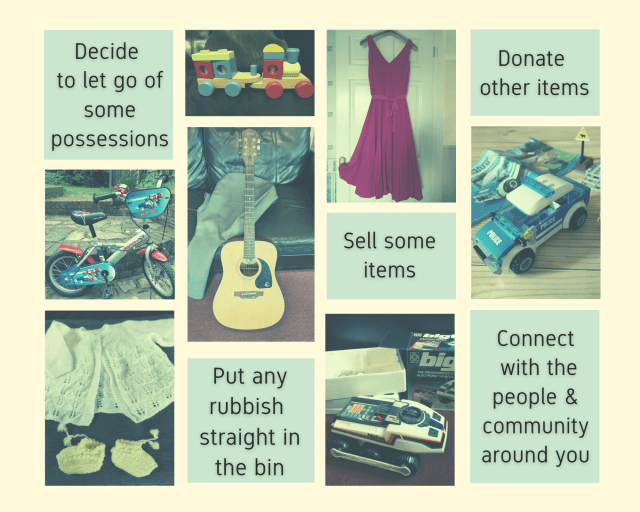
I decided that I would sell or donate this category of items. I decided to sell the more valuable items, as this would help me feel like my efforts were contributing to the family finances. I decided to donate the rest to good causes.
As I started the process of finding my secondhand items new homes, I discovered that by selling and donating my items I was also learning about my local community and making closer connections with the people around me.
The actual process of minimising my belongings, helped me to make better social connections. This in itself was good for my wellbeing. I found the process to be calming and life-affirming.
Examples of the Good Connections Created by Donating and Selling our Belongings
My Son’s First Bike
The first item I decided to let go of was my son’s first bike. It was almost brand new. He had only used it for a short while before he grew out of it.
Financially it seemed worthwhile to sell it. Removing this item from our home also had a big impact on our surroundings. It created lots of space both in the shed and in the home. The main bike was stored in the shed. The accessories for the bike had been kept inside the house (e.g. stabilisers, tools and a little rucksack-style bag that had come with the bike that my son had never used).
I felt confident to let go of this item because it was something my son could definitely no longer use. He was far too big for it. In fact, he was already the proud owner of a larger-sized child’s bike that he was learning to ride instead.
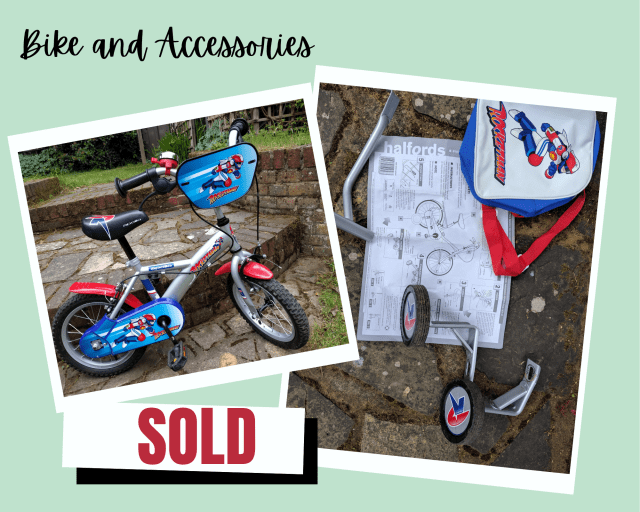
I took photos of the bike and it’s accessories. I advertised it for sale at a very reasonable price on a local Facebook sales group. I used a local group which had invited members only. I felt more confident dealing with people who lived locally rather than a wider group of people. I also liked the idea of a local young child using and enjoying my son’s old bike.
I received some very prompt interest in the bike and arranged a time for a lady to come and collect it. When she arrived, she was accompanied by her young son who would be using the bike. They both loved the bike and seemed very happy with their purchase. The son loved the rucksack-style bag and put it on straight away. I enjoyed chatting with the mum and her son while selling them the bike.
My final image of my son’s first bike will always be the new little owner riding away on the bike supported by his mum and proudly wearing his new little rucksack on his back.
This one moment created a new memory for me. It gave me much more joy than seeing the bike stored in our cluttered shed or moving the bike accessories from one storage place to another inside the house as I tried to tidy up.
I have never once regretted letting go of this item. As you can see I have a great photograph of this bike that I can continue to treasure. I also have other photos of my son actually riding the bike. I do not need to keep the physical bike to keep the memories alive. The memories will always be alive and well inside my head. If I want to share those memories with others I can always show them the photos and tell stories about my son riding his first bike.
My son has never missed his bike. Once he was too big for it he, obviously, had no interest in riding it. He was not emotionally attached to his first bike and simply enjoys riding his larger bike instead.
Selling Items at an Indoor Boot Sale
One of the next arrangements I made to sell some of our items was to attend a charity event at the local secondary school. The event was called an “Indoor Car Boot Sale”. It was basically the same as attending a normal Car Boot Sale but it was held indoors. Instead of leaving your items in your car, you were given a table to display your items for sale. This was basically the equivalent of me holding a yard sale, but instead of selling from my own yard, I was selling at an organised event out in the community with other sellers.
This charity event was run by the school’s Parents Association to raise money for the school. I paid a fixed fee for the use of the table and kept the profits.
The school I attended for the sale was the secondary school my son was due to join when he finished primary school. It was good for my son to attend the event with me and become familiar with the school hall and its surroundings.
It felt good to be making a donation to the local school. We also ran into some familiar faces from the local area to socialise and chat with during the event.
This was not the most profitable or efficient way to dispose of items. I attended the event twice. On both occasions I brought quite a few items back home with me!! And let’s just say I was far from a millionaire by the end of each sale!!
However, it was a good start at letting go of a number of smaller items all at once. It was also a great way to get me out of the house and into the world on a weekend morning!! It was enjoyable to speak to the people who bought our items. Often the customers were children who were excited about getting a new toy or a grandparent buying a little treat for their grandchildren. It was nice to see the smiles on people’s faces in person.
Wooden Toys and a Local Childminder
When my son was a toddler we accumulated quite a few wooden toys for him. Among other things, he had a wooden pull-along truck, a wooden fold-away castle, a wooden educational clock and an abacus. These items were still in lovely condition when he had finished playing with them. I decided to sell them locally online. I did so by selling them in very reasonably priced batches.
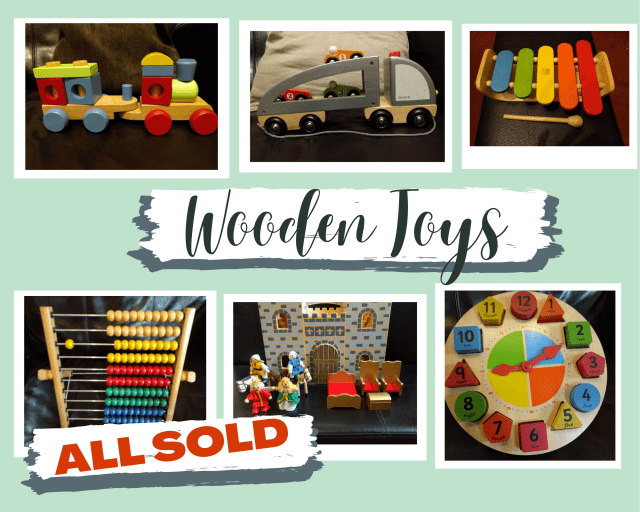
Through selling these toys, I made a lovely connection with a lady who had just become qualified as a childminder. She was in the process of setting up her home for her first intake of children. She loved the wooden toys and after buying her first batch, she asked me to let her know if I had any more to sell. After that, I contacted her directly each time I thought I had something educational, wooden or suitable for her childminding business. She bought quite a large number of items from me.
One day she told me a lovely story, which created another new memory for me to cherish. She told me that she liked her wooden toys so much that she had displayed them all in a prominent place on one shelf as a collection. She told me that one day another childminder was visiting and asked where she had got all of her lovely toys from. She said she had told the other childminder that she had a “nice lady who had provided them to her”. It gave me great joy to think that they were so grateful for these items.
The childminder also told me that the wooden castle had been a particular success because there was one girl who would head straight for the castle and start playing with it every morning as her parents dropped her off. It was great to think of this castle still being played with.
Every time I look at my photos I feel pleased to think that these toys that my son had once enjoyed are still bringing joy to other children. I am content that I made the right decision to let these toys go from our home because now they are still used and loved as toys should be.
Donating our Unused Musical Instruments to the Local School
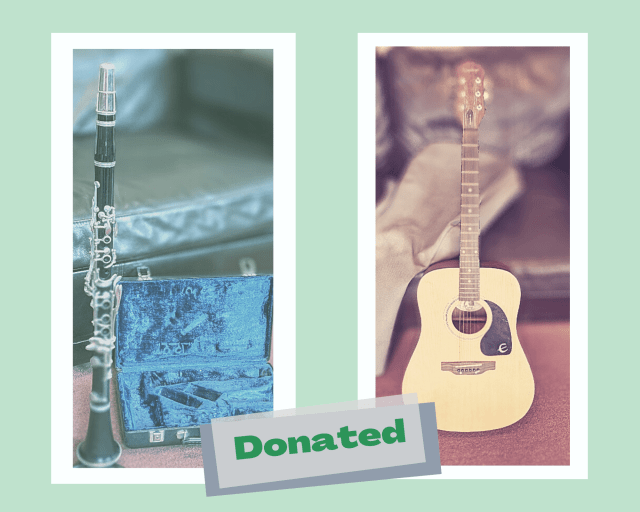
We saw that our son’s school was making a request for second-hand musical instruments. They were asking for instruments to be donated to the school to allow young students who wished to take up a musical instrument a better chance of owning their own instrument to learn and practice on.
When I was young, I played the clarinet. My partner played the guitar in his youth. We had been storing our instruments buried under lots of stuff in an upstairs cupboard for years without either of the instruments being played.
This was a hard decision for both of us, as we both had quite a sentimental attachment to these items. However, we both decided that we needed to admit to ourselves that these hobbies were hobbies of the past. We were very unlikely to take them up again in the future. Also, we own a piano (which we have absolutely no plans to let go of). We both felt that if we did decide to start playing music again we were both more likely to sit at the piano and play rather than play our clarinet or guitar.
We decided to contact the school and ask them if they would like our clarinet and guitar. They were quite large and difficult items to store and releasing them would free up a lot of valuable storage space for items we currently use.
We both realised that seeing our instruments abandoned in the cupboard (at the risk of becoming damaged) made us feel even sadder than letting them go. We felt it would make us much happier to think that a young person was able to get the enjoyment of learning to play an instrument as we had done when we were young.
When we contacted the school they were extremely excited to receive our offer and said it would be “absolutely amazing” to receive the instruments. They said they would definitely put both instruments to good use.
We dropped them off at the school and it is great to think of young people bringing the instruments to life again and making music with them.
Our Lego and a School Lego Therapy Group
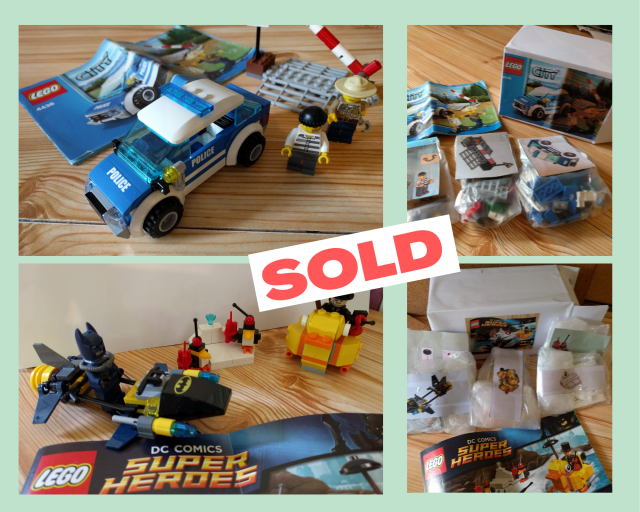
My son had a lot of Lego kits. In reality, he was never really someone who built Lego kits. He was more likely to build his own contraptions or use Lego bricks in his own way alongside other toys. For that purpose, he preferred the larger more regular-sized Lego bricks. Most of the sets had been built once and then become mixed in with all the other Lego. Often, it all ended up tipped out on the floor.
I decided to try and sell some of these Lego kits locally online. We still had the instruction booklets and some of the boxes. I was able to use the instructions to reassemble the kits by sorting through our mixed-up general Lego box for the correct pieces. I built each Lego kit to check we had all the pieces. Once it was built I took a photo of each kit to prove to potential buyers that all the pieces were present. I then dismantled each kit and packaged them in my own bags and boxes so that anyone who bought them would be able to open up the bags and build the kits, following the instructions, as they would have done with a new kit.
I advertised the kits in batches online. When I advertised the first batch I was contacted by a lady who worked at a school. She ran a Lego Therapy Group. She bought the first batch I advertised and when she came to collect the Lego, she was so grateful and said they were always looking for reasonably priced kits to add to their collection for use in the Therapy Group. She said it was important that the instructions were included. In the Therapy Group, the kids would follow the instructions. They worked together as a team during their sessions.
She asked me to let her know if I had any more kits. So, once I had checked the rest of our Lego kits, I contacted her again and she bought those kits too.
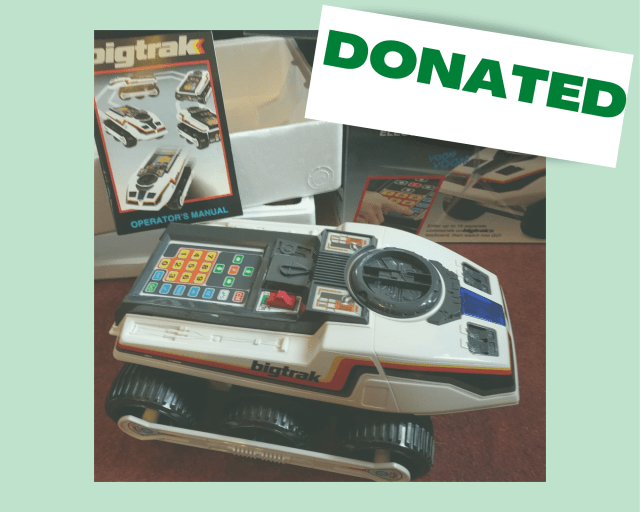
We also had an old “Big Track” toy. It was not in full working order because our son did not like the noise it made. We had removed the sound card that gave it the ability to make noises and used it silently. However, you could still give the “Big Track” instructions for it to navigate across the room as it was designed to do.
I realised this was another toy which involved following instructions to make it work. Young people could work as a team using the “Big Track” too. I, therefore, contacted the lady from the Lego Therapy Group again to ask if they were ever interested in toys other than Lego for their group. I told her about the “Big Track”. She said they would be very grateful to take it for their group. She even thought there was a member of staff at the school who might be able to fix it to enable it to make sounds again. I donated this item to the Lego Therapy Group because it was not in full working order.
It was great to think that our Lego that had just been sitting in a muddled pile and causing disruption every time it was tipped out on the floor would now be put to such a constructive and worthwhile use.
It was great to think that the “Big Track” might even receive a refurbishment and be restored to full working order, rather than being shoved in one of our cupboards.
This was a very worthwhile connection that I never expected to make. Lego Therapy was a wonderful group running in our local area that I had no idea existed until I started letting go of our items.
My Old Summer Clothes and a Lady Due to Go on Her Summer Holiday
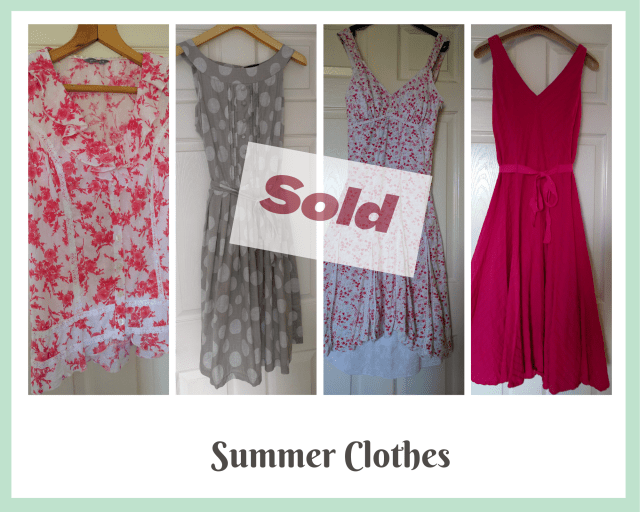
I had a few items of summer clothes that I had owned for a number of years. I had only worn them once or twice on holiday and they were no longer suitable for me to wear. They were just sitting unused in the wardrobe taking up valuable storage space.
As they were in nearly new condition, I decided to sell these items. I took photos of them and put them online to sell locally. A lady bought them and when she came to collect them, she was so grateful as she was going on her summer holiday the very next week and wanted something new to wear. She asked me to let her know if I ever had any more similar items to sell as she said she would definitely be interested in them if I did. This connection seemed to bring joy to the lady who bought them just in time for her holiday. The knowledge that my dresses had gone to such a grateful new owner who would take them on holiday with her gave me a lot of joy too.
Very Sentimental Items – knitted Baby Cardigans, Mittens and Bonnets
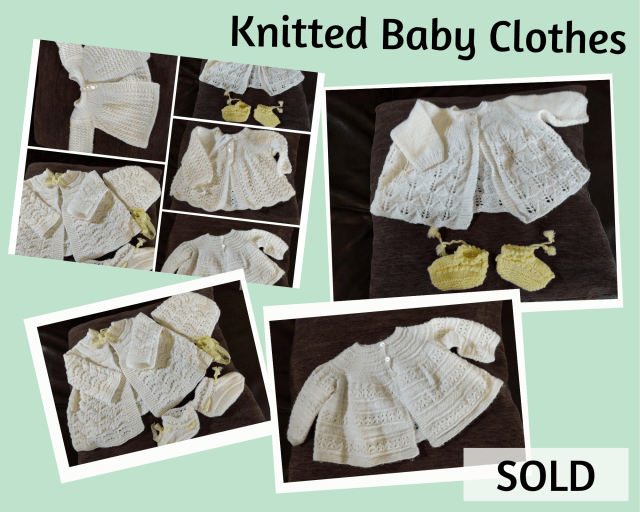
I had been storing some knitted baby cardigans, mittens and bonnets. These clothes were not my son’s baby outfits they were clothes that my grandmother had knitted for me when I was young to dress-up my toy doll. They were beautifully hand-knitted items.
I have very fond memories of my grandmother knitting items for me to wear throughout my childhood. She also knitted a number of items I requested for my toys, including this collection of baby clothes that I had saved.
My grandmother has since passed away. I am very fond of the memories of my grandmother that these items provide. I had to think carefully before I came to the decision to let them go. However, in the end, I realised that I would always have the photos of these items to prompt my memories and, in fact, I do not need a prompt at all. My memories are inside of me and I will never lose them.
I advertised the collection online. I am so glad I did. A mum, who I know from my son’s school, got back to me and said she would love to have them. She said she had recently become a new mum and would use them for her new baby.
Once I delivered the items to her, she sent me a lovely message telling me how beautiful she thought they were. Contained in the message was a picture of her young baby wearing one of the bonnets that my grandmother had knitted.
It was so good to see my grandmother’s craftmanship in use again. I instantly knew I had made the right decision to let the items go. My grandmother would have loved to have seen one of her creations being worn again.
My General Experience
As you can see, I generally had very positive experiences when starting to let go of some of the items from our home.
Along with the specific examples I have shared above, I also sold other items and made more donations. Here are a few examples:
- I let go of my son’s old school uniform when I found a lady who collected second-hand school uniforms to pass on to others who needed them.
- I donated items to school fetes (e.g. Lego stickers and soft toys).
- I donated lots of our old pencils to a school charity that was collecting the pencils for an organisation that worked with schools in Africa.
I began to proactively look out for local events and organisations that were looking for donations. Each time I became aware of someone looking for donations, I took time to consider whether we had anything we could offer them from our home.
I met lots of friendly, kind and interesting people and learned a lot about my local area.
I do not regret selling or donating any of these items. I am very confident that our items have all gone to very good and worthwhile new homes.
I hope the examples I have shared are encouraging. I hope you now feel reassured that you will not regret letting go of some of your items, even if you have sentimental feelings towards them. The physical items do not hold the memory. The memory is inside you.
Letting go of the item does not erase the memory. In fact, by selling and donating your items you are creating new memories in relation to those items, such as watching a young boy enjoy your son’s old bike or being told how worthwhile your Lego is to a local Lego Therapy Group.
Also, in the process of selling or donating your items, you will have created photos of them. These photos will pop up as memories on your phone throughout the year. I believe looking at these photos and remembering all the memories, both old and new, is much more life-affirming than spending time and energy maintaining and storing the unused physical items within your home.
I found that making good connections, by reaching out to people in my local community to sell and donate our items, was a much more fulfilling and energising way to spend my time than being stuck at home alone cramming things into cupboards in the hopeless attempt to contain all of our things to try and make some tidy spaces for us to live in. If you give this a try I hope you will feel the same way too.
The Impact on our Home and our Wellbeing
The Physical Impact on our Home and How we Live in the Space
At the time I started experimenting with minimalism, I did not know I was going to write a blog post about my experience, so unfortunately I do not really have many photographs to demonstrate the impact that these initial efforts to minimise our items had on our home.
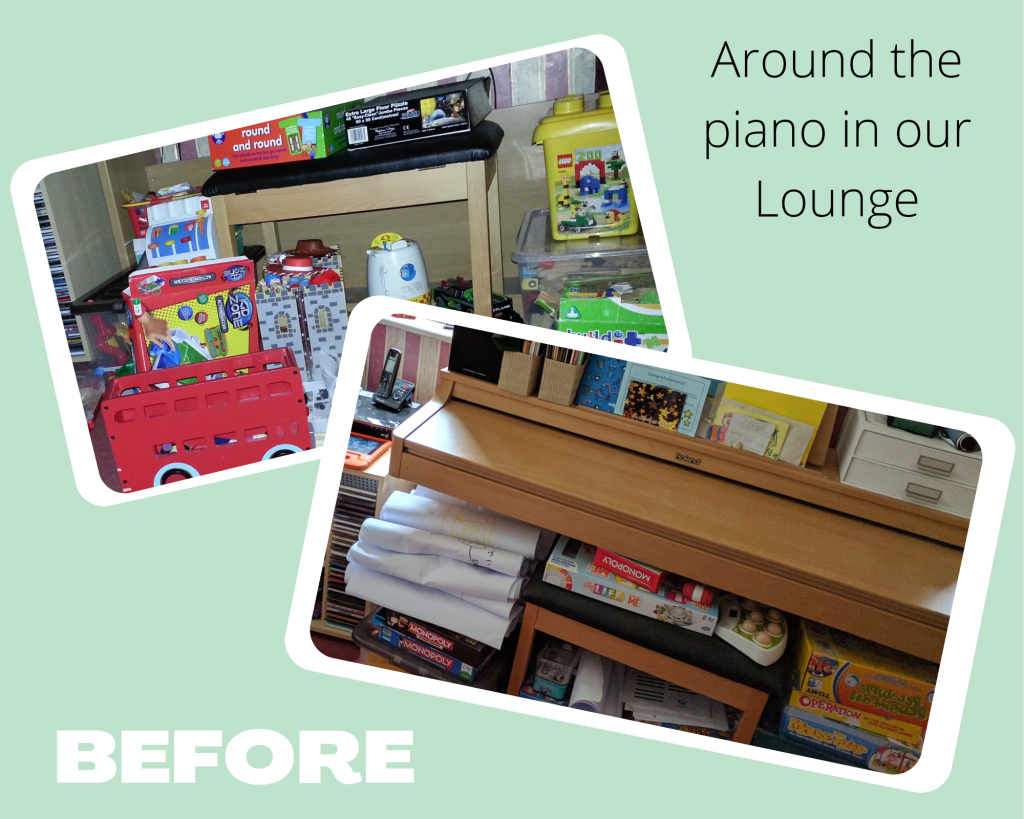
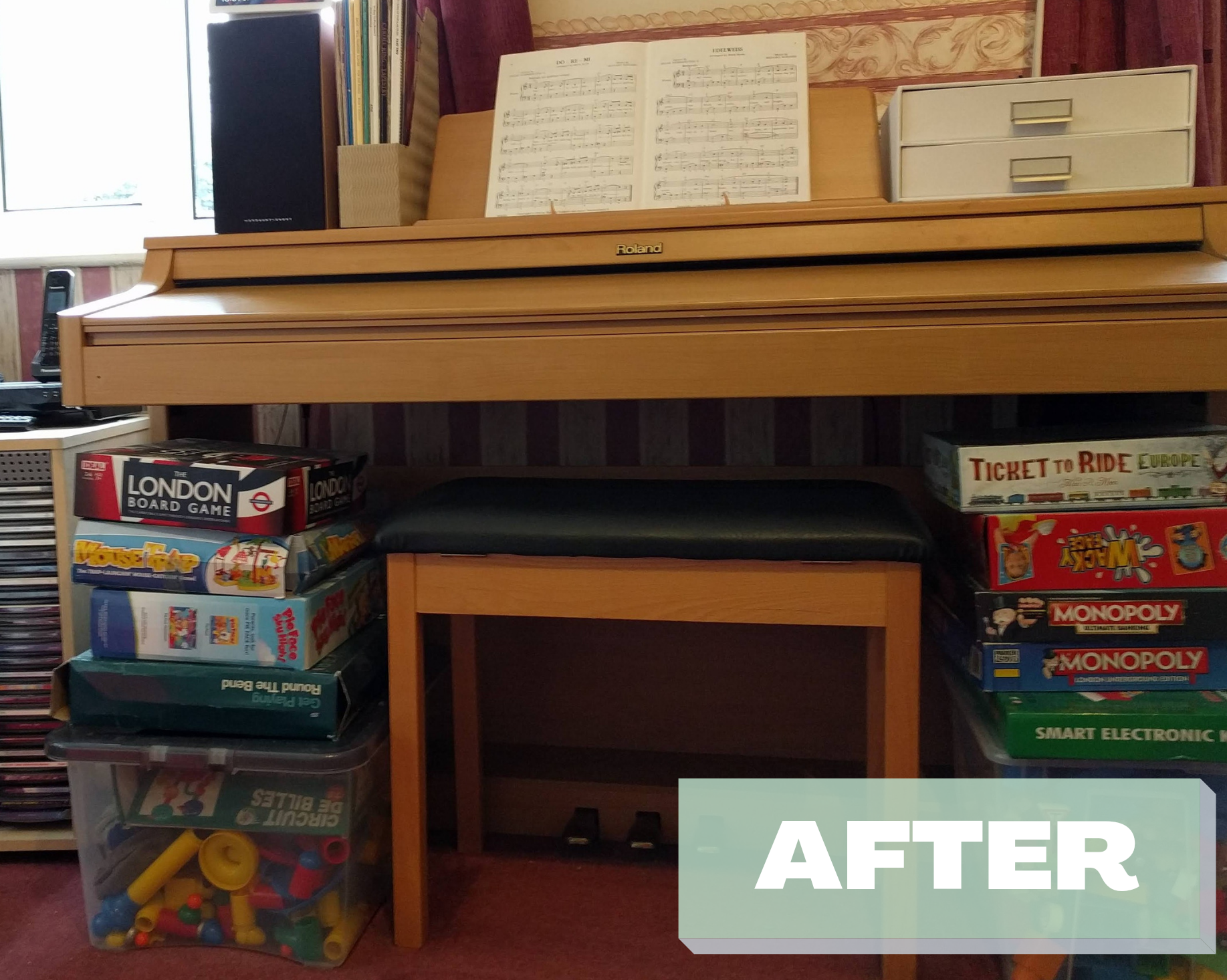
However, I have managed to find the photographs I have included above which show the impact on one small area of our home. The photos show the area around our piano in our lounge before I started letting go of some of our items and the same area after I had started minimising our possessions.
You can see that these photos do not really show an “Instagram-worthy” room transformation. However, if you only take one thing away from this post, I hope it is this: Making a room look more impressive to others is definitely not the point of minimalism. The point of minimalism is to change how we live and how we use our own spaces. It is about the freedom created in our lives once some of our possessions are removed. Removing some of our possessions makes more space and time for us to spend with the important people in our lives.
I hope the explanation of my before and after photos provided below will provide a good example of minimalism in action.
Before
The photo shows that before I decluttered, it was not possible to sit at the piano. The piano had basically become a storage area for our random things.
The top of the piano was covered with papers, files and other random items. Toys were stored on and around the piano stool. All of the space under the piano was taken up with more toys, board games and my son’s rolled-up artwork. Bigger toys were stored in front of the piano taking up some of our valuable lounge floor space.
This was not a calming scene. It was very difficult to keep all of these things tidy and contained in the area. My son was able to grab at random things in his view and this caused a constant mess that needed to be tidied up daily. All the visual clutter made the lounge feel very busy and much smaller than it should.
After
After letting go of some of our items you can see that this area is much improved. We can now sit at the piano to play it.
The music stand is free of clutter and the book of sheet music currently in use is the only thing that is now stored loose on the top of the piano. The rest of the piano top is tidy and anything that is stored there has been placed there intentionally.
The stool is empty (both on top and underneath). It is free to be pulled out to sit on without having to move anything. This is not only useful for playing the piano, but the stool is a great extra seat for guests to sit on when they visit.
There are still some toys stored in the side areas underneath the piano, but they fit very easily there. They do not spill out into the room. We have a lot more floor space around the piano than we did before and I am happy for those items to remain there.
The items stored in the side areas are the age-appropriate toys/games currently in use. The items are all safely stored in boxes and all have a proper home. These items are used regularly and are easily tidied away afterwards into their correct storage boxes. There is nothing lying around loose for my son to randomly grab at.
Everything in this area of our home has a proper storage place. Items are put away and out of sight, but each item in the area is easily accessible and can be used for its intended purpose when we choose to do so.
There are no loose messy items on display. Visually this is a much more orderly scene. Practically, it is less likely to get messy as my son is less likely to randomly get things out.
The impact that minimising has had on this one small area has been vast. This is a very good example of an area of our home that is now being used to live in (to play the piano, play board games, play with toys and entertain guests) rather than being used purely as a storage area for our unused possessions.
Minimising the possessions around our home has had the same effect on other surfaces and in other floor spaces in the rooms all around the house.
Minimising our old and unused clothes, has also had an impact on the size of the laundry pile and made storage of the clothes we are currently wearing easier.
The overall impact that this has had on our home is very significant!!
The space in our house visually looks different and it feels different too. Each time I minimise an area of our home, my son notices it and comments about how much he likes the space.
The first time the piano was made easily accessible to play, my son returned home from school, walked straight up to the piano and started playing it. Before that day, he had never returned home from school and asked me to clear the space to play the piano. This demonstrates how minimalism creates a welcoming home for the people who live there. People have the space they need within the home to live free and full lives.
It feels absolutely wonderful to be surrounded by less stuff. It also definitely saves time when it comes to house cleaning routines!!
The impact on our Wellbeing
The piano is one of the first things guests and our family see as they walk into our lounge. Knowing this area is tidy (or easily tidied) is very reassuring to me. This area looks and feels more spacious and tidy and this is definitely good for my wellbeing. It really does help to reduce stress in our home. It makes the room feel better day-to-day. It is an easier space to live in. There are fewer unnecessary distractions in the room. This enables my son and me to have more focused conversations. Minimising has also helped me to be more confident about inviting guests over to our house.
You will remember that I set out hoping that “thinking like a minimalist” and taking some initial steps towards implementing minimalism throughout our house, would address the main stressors in our home.
I can confirm that each time I minimise an area of our home it does add an element of calm to our home and our lives. It is definitely worth the effort and worth a try.
These first steps into minimalism have also had some wider and more unexpected effects on me and how I think about our home.
Getting rid of some of our possessions has helped me to feel more confident about my house. However, thinking deeply about who my home is actually for and how I wish to use my home has been equally impactful.
I have realised that I am not running a “Show Home”, I am trying to create a comfortable place for our family to live and a welcoming place for friends and family to visit. I am not trying to create a picture-perfect or curated showpiece to be admired from afar by all. I am managing a home that is specifically designed to be used and lived in by us (my partner, my son and me) and those loved ones that we choose to invite into our home. If the home is functioning for us and we are happy with how it looks that is all that matters. It does not matter what anybody else thinks.
I have also had to question the belief that I have been holding onto that visitors to my home will judge me if it is not perfectly clean and tidy. I have realised that it is very rude of me to think that my guests (family, friends and loved ones) will judge me for the state of my house. What a thing for me to think about the people who love me!!
Having come to the conclusion that this belief is flawed and not factually true, it has encouraged me “to take the risk” and invite people around to my home more often and just let our guests “take us as they find us”. So far, none of my family has disowned me and I have not lost any friends, so it seems the risk is worth taking!
Similarly, I have had to question my belief that I am “not allowed” to go out and enjoy myself if I am not on top of the housework. I have realised that this self-imposed belief is also not based on truth or fact. I do not need to earn my right to step out into the world. There is no such thing as a house inspector that is going to come and inspect my house and “tell me off” for leaving the house while it is untidy, what a ludicrous idea!! It is our home and we get to decide when to tidy up and when to leave it and go out for the day.
Going out is not a reward for getting all-the-things done (in fact tasks such as housekeeping will never be complete, they are ongoing tasks that will always be there). Everyone has the right to go out, connect and socialise with others. You are worthy of enjoying your life, regardless of how tidy or organised your house and home are. In fact, going out into the world and meeting up with others is an essential ingredient for protecting our wellbeing.
I am not an expert on minimalism and if you were to visit my house and visually look around, I’m sure you would not immediately think it looks like a minimalist’s home. For me, taking my first steps into minimalism has not been about how things look or how many possessions I still own. It has been about changing my relationship to my house, my home and how I think about the possessions I decide to keep in my home.
Minimalism has been instrumental in helping me to understand that my home is for me and my family. We get to choose how we set up our home and how we live in it. It is not a status symbol for others to admire. It is not a stick of judgement to beat myself with. It is not a prison to live in until I deserve to come out for a treat. My home is there to help me live my life. It is a safety net for me and my family to return to. It is a springboard to bounce off into the world.
Closing Thoughts on Minimalism
I hope this post helps you to realise minimalism is useful for all people. Each person who pursues a minimalist lifestyle can choose what minimalism will look like for them.
Minimalism is an overriding concept that can be interpreted by you to help you improve your home and your life according to your family’s unique needs. It is not a specific set of rules for life that have to look one certain way.
By minimising, you will end up with fewer possessions. More importantly, you will end up with more life.
Minimalism is not about restricting yourself or depriving yourself. It is about making decisions about what is important to you. You can then remove the things that are not important. You will then end up with more of what you really want in your life.
This is what I mean when I say that “I think like a minimalist”. I make decisions for my house, my home, my family and myself based on this concept of making room to live my life more fully.
The Purpose of Minimalism Discussions Here at Creating Calm With Clare
I have read, watched, and listened to a lot of information about minimalism. However, I want to make it clear that I am not claiming to be an expert on minimalism.
Minimalism is a large topic and I have not even attempted to cover all of the discussions about it here. In this post, I just hope to offer an entry point into this topic by providing a small insight into one way I have started to “think like a minimalist”. I wanted to outline one step I have taken to implement the teachings of minimalism in our home and how it has benefited my family and me.
If you would like to read more about minimalism, I have recommended some resources at the end of this post that I have found useful and may be helpful to you.
I am of the strong belief that aiming for a similar lifestyle to that of a minimalist can be one very important step towards living a calm life.
Here at Creating Calm with Clare I will refer to minimalism purely in terms of it being one very important piece of the puzzle when creating a calm life for yourself. My posts on this topic will therefore concentrate on the specific elements I have tried and tested in my own home. My discussions will concentrate on how the implementation of some of the teachings of minimalism contribute to creating a calm life in our house, our home and in our lives in general.
The concept of minimalism has led us to make some quite big changes to how we set up our house, deal with our possessions in our home and structure our lives. So, I definitely hope to return to this topic in future posts.
I hope having read this post you feel a sense of freedom that will allow you to step out into your community and spend time with family, friends and the important people around you.
Please remember, you get to decide for yourself how and where you and your family spend your day, regardless of how tidy or organised your house and home are.
If you give minimalism a go in your own home, let me know the impact it has on how your house feels and how your home runs in general.
If you have some positive experiences you would like to share about donating or selling your items and making connections with people and organisations within your community, I would love to hear from you in the comments.
If thinking about minimising some of your possessions and how you want to run your home has led you to question some of your long-held beliefs about your house and home, I would love to hear about them.
I wish you a happy and joyful day.
Clare
Resources
Books
- “Goodbye, things” On Minimalist Living, by Fumio Sasaki (Penguin Books, 2017)
- “Everything That Remains”, A Memoir by The Minimalists -Joshua Fields Milburn and Ryan Nicodemus (Asymmetrical Press, 2014)
- “The Life-Changing Magic of Tidying”, by Marie Kondo (Vermillion, 2014). [Please note, I found Kondo’s book particularly useful when thinking about minimising and storing clothes].
Follow Me on Instagram
(You’ll find me @its_calmwithclare)
Click the Instagram link below to visit My Profile page and discover Posts, Reels and Stories about all things calm. I generally post each week on themes relating to the “Featured Post” on this blog*.
Follow Me on Pinterest
(You’ll find me @calmwithclare)
If you would like more inspiration and to explore a variety of resources about minimalism you may wish to click the link below and take a look at my Saved Pinterest Board “Minimalism”.
I would love for you to join me on Instagram and Pinterest.
*Please visit this blog’s About page to find details of this week’s featured post.
Visit the About page now to design your reading plan for the blog
 Creating Calm with Clare