
Calm Parent – Calm Child
Please Note The information included in this blog post was originally published (in 2022/2023) as part of a two-part series. I am now re-blogging it as part of a 6-Part series to ensure ease of reference for the reader.
This blog post is the final part of our 6-Part series about how you can calmly complete homework with your young children.
In this blog post, we will be discussing the helpfulness of preparing modified resources to help your children complete their homework more independently.
We will also consider how you can use your imagination to make things more fun, by completing homework tasks in an innovative way.
Finally, we will discuss when you may need to ask for help from experts and seek support from others outside of the home. Some examples of how you can seek help and connect with others are included to help you avoid struggling alone in silence.
For interested readers, and to put this post’s topics into context, I have included an overview of the whole Calm Homework Series in the next section below.
If you prefer, you can scroll past this “Overview Section” and skip straight to this post’s topic which focuses on preparing modified resources, completing homework in fun and innovative ways and seeking help outside of the home when needed.
Overview and Summary of This Calm Homework Series
In Part 1 of this series, we discussed how to create a “Good Homework Culture” in your home in preparation for the calm completion of homework tasks.
In Part 2 we considered an overview of 10 Practical Ideas that can help with the completion of individual pieces of homework. We looked in detail at how familiarising yourself with the school’s expectations for homework is an important and very helpful step towards becoming thoroughly prepared for supervising homework.
In Part 3 we considered how you can identify the best time of day and the best days each week to do homework with your children. We also discussed how you can prepare your home environment for each homework session.
In Part 4 we considered how you can mentally prepare yourself, as the supervising parent, for each homework session. We will also discussed how to reduce anxiety for your children by separating the process of choosing which task to do from actually completing the task.
In Part 5 we discussed how you can gain clarity about the nature of the task set by the teacher. Namely, whether the task is “Time Limited” or “Task Limited” and understanding the Learning Objective behind the task.
We also considered how you can identify your child’s favourite subjects and their preferred learning style and use your knowledge to help when approaching homework.
If you have not yet read the first five parts of this series, I would highly recommend taking the time to visit and read them before continuing with this post. Reading the series as a whole will help you to get the full benefit from the practical ideas contained in this post (Click Here for Part 1).
For ease of reference, here is a summary of the 10 practical ideas that I discuss throughout this series along with links to each part. Please note, the ideas listed in bold text (Ideas 9 and 10) are the subjects I will be discussing in this blog post: –
- Familiarise yourself with the school’s expectations for homework (Part 2).
- Identify the best time of day and the best days each week to do homework with your child (Part 3).
- Prepare your home environment for each homework session (Part 3).
- Mentally prepare yourself for each homework session (Part 4).
- Reduce anxiety by separating the process of choosing which task to do from actually completing the task (Part 4).
- Be clear as to whether the task is “Time Limited” or “Task Limited” (Part 5).
- Identify your child’s favourite subjects and their preferred learning style. Use your knowledge of their preferences to your advantage when approaching homework (Part 5).
- Identify the underlying learning purpose (or learning objective) behind the task and be clear about what the teacher wants your child to learn before starting the task (Part 5).
- If you think it will be helpful to prepare some modified resources to help your child complete their homework more independently, get those resources organised before you and your child sit down at the homework table (Read on Below).
- Use your imagination to make things more fun, if necessary, by completing the homework in an innovative way (Read on Below).
Practical Ideas 9 & 10 – Preparing Modified Resources to Help Your Children Complete Their Homework More Independently & Using Your Imagination to Completing Homework In an Innovative Way
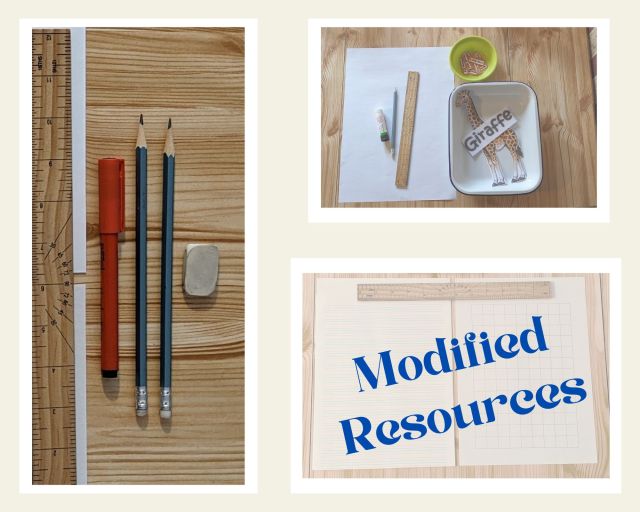
If You Think it Will be Helpful, Prepare Some Modified Resources In Advance to Help Your Child Complete Their Homework More Independently During the Homework Session
Sometimes the best way to prepare for a homework session is to take some time in advance to create some modified or additional resources to help your child with the homework task.
If you have read the whole of this six-part blog series, you might be thinking that all of this feels like a lot of work for parents! It might feel like you are taking on all of the hard work yourself and taking away all of the responsibility for doing the homework from your child.
Please be reassured, that this is not the intention of this process at all.
The intention when creating the resources I am going to recommend below is to allow your children to complete their homework tasks as independently as possible during the homework session itself.
In fact, what you are doing is replacing the stressful, less effective, “hands-on” type of help that you are probably currently providing your child during the homework session, with some more effective support prepared in advance.
Although this might feel like it will take more time and effort, in the long run, you will probably find that this is not in fact the case. Preparing some amended resources in advance can enable you to have a calm, intentional and worthwhile homework session with your child. This can in fact use up less time and create less of a mental load on you than trying to cope with unsatisfactory and stressful homework sessions regularly each week.
When accounting for your time and efforts, it is important to remember that this process of preparing amended resources is only intended to be a temporary measure while your child is still young and still learning how to cope with their homework.
This is a support mechanism while they are still dependent on your guidance about how to learn at home. The long-term intention is for you to guide them toward independent learning at home as they get older.
Preparing resources in advance, so that your child can enjoy completing tasks happily and independently during their homework sessions, will hopefully build up your child’s confidence more quickly. This should enable them to independently take on the responsibility for their own homework sooner.
In the alternative, if they are constantly experiencing negative homework sessions where they feel like they “can’t do it” and are “failing”, the opposite will happen and they will never want to complete their homework independently or at all!!
It is also worth remembering that I am not recommending creating amended resources for all pieces of homework. I am only suggesting it as an option for those homework tasks that you know your own child does not enjoy or struggles with.
Some homework set by the teacher will be tasks that you know your child can do and will enjoy. Those tasks can simply be completed by your child as set by the teacher.
The pieces of homework where amended or additional resources might be necessary can be identified by using the knowledge you have gathered about your own child’s learning preferences and interests (See Idea Number 7 in Part 5 of this series for full details of how to gain an overview of your children’s unique learning preferences and interests).
Overall, when thinking about how much time this will take up for you, it is important to remember that you will only be taking time out of your day temporarily, sometimes and for some tasks. This phase should not last forever and the time investment should gradually decrease as your child grows older.
As each child is different, you will obviously need to create resources that are specific to your own children’s needs and interests. However, I have provided some examples below of various amended resources we found helpful during our son’s homework sessions. Hopefully, these examples will inspire you to come up with some of your own ideas for your own children.
Amend Worksheets, Change Paper Size, and Provide Different types of Paper and Writing Materials. Create Your Own Templates
I have referred to this type of amended resource in earlier parts of this blog series:
- I have suggested cutting up and amending worksheets to leave more space to write the answers.
- I have suggested providing either a bigger or a smaller piece of paper to ensure the paper provided is the size that will be the most inspiring and the least overwhelming for your child.
- I have mentioned how you can provide wide-ruled paper or special handwriting paper for your child to write their answers on.
In addition to those ideas already mentioned, you could also try the following:
- For maths homework, you can provide squared maths paper with larger squares so your child can write their numbers bigger.
- You can encourage your child to write in pencil so they can rub out any mistakes. This can remove the fear of errors. Provide them with a good quality eraser so that they can successfully rub things out cleanly and without damaging their piece of paper.
- If your child does not feel comfortable writing on paper at all, you can provide them with a whiteboard and an erasable pen, or a blackboard and some chalk. You can take photographs of their work, print them out and stick them in their school book for the teacher to see.
- Sometimes, instructions are sent home in the form of a crowded instruction sheet with a small typeface. You can use a photocopier to blow up the size of the text by 50% to make it easier for your child to read. If you do not have a scanner or photocopier available at home, you can ask the school to do it. I understand that schools need to be able to offer this service to meet the needs of visually impaired students, so they should be able to provide it for your child too if it helps their learning.
- If the homework is not presented in the form of a worksheet, your child may be faced with a blank piece of paper that they find daunting. In those situations, you as the parent can decide to create your own “worksheet” or template to guide your child and inspire them to get started. You can refer to the worksheets that you have seen sent home from school to inspire you. You might remember the example of the homework asking the children to prepare a fact file about giraffes (see Part 4 and Part 5 of this blog series for details). For that “giraffe” homework, you could design a template on a piece of paper for your child to fill out that includes the following:
- A large box for your child to enter the title of the fact file (e.g. “Giraffe Facts”).
- A square border for your child to stick a photo or picture of a giraffe into.
- A page divided into large columns (like a newspaper). Your child can write, type or stick their giraffe facts into the columns provided.
- Set out your template page on the homework table with any other equipment required at the outset of the homework session. Such a template is good for motivation. It provides them with a visual structure to work through. They know what they need to do and where to start. When the whole template is filled out they know they have finished and can stop working.
Any special sheets of paper or amended resources that you have provided for these kinds of homework can be attached to your children’s homework book or folder. If an explanation is required to explain to the teacher why the homework is presented differently, you as the parent can add a note to the homework for the teacher to read when they review it.
Cut-Out Items and Collect Materials Together Ready for Your Child to Use During the Homework Session
If the learning objective for the homework is not “arts and crafts” and not to improve their skills at using scissors, it can really help to cut things out so they are ready to use during the homework session.
See the explanation and photographs provided in Part 5 of this series for the example of creating a picture of a giraffe and labeling it, with the learning objective of learning about giraffes.
You can separate this “giraffe” homework into three phases:
- During the first session, you can sit with your child at the computer, or with a book or magazine and allow them to do some research. They can select any giraffe pictures and facts they would like to use for their final piece of work. You can print out or photocopy the pictures and information your child chooses. That completes the first phase.
- Before the next homework session with your child, you as the parent can work alone to cut out the pictures and factual extracts to the correct size. You can cut the words and facts into sizes appropriate for use as labels to stick around the giraffe picture. That completes phase two.
- When setting up the homework station before your child sits down to complete the final phase of their homework, you can place all the items you have cut out onto a tray on the desk. You can place all the other equipment required (such as a glue stick, a pencil and a ruler) on the desk too. Your child will have everything they need on the desk in front of them so they can immediately begin independently creating their labeled giraffe picture. The completed picture will summarise the knowledge they learned about giraffes during the research they completed during the first homework phase.
You can see how you as the parent taking the time to cut things out in advance (bearing in mind that scissor skills are not part of the learning objective for this task) allows your child to enjoyably concentrate on the central learning objective of the homework without getting frustrated or upset by jobs that are not central to their learning for that particular task.
Another example of when cutting things out for them could be helpful is a situation where you are providing cut-out pictures for them to complete a maths homework where drawing has been included in the task to “make it fun” but your child does not find it fun to draw.
You will remember the example I mentioned above about gluing and sticking pictures of coins during a maths task where the learning objective is about making calculations with coins while shopping.
For that maths task, your child does not need to be involved in finding the pictures of the coins because “researching coins” is not a central learning objective of the maths homework. Therefore, you as the parent can find some pictures of coins that you think will be suitable for use in the maths task in advance of the homework session. You can cut them out in advance of the session too.
When preparing the table for the homework session you can place the cut-out paper coins in a bowl and make a glue stick available ready for your child to use. When your child arrives at the homework table they can start doing the maths calculations and showing their answers on the page using the cut-out coins immediately. They will be focused on the learning objective and will not be delayed or emotionally upset by the non-essential task of either drawing or cutting out coins.
Research Video Tutorials to Help Inspire Your Child To Do The Homework
Sometimes watching a simple video or tutorial showing how to do something on screen can be helpful to motivate your child to do the homework.
A quick video can be a more enjoyable and pain-free way of allowing your child to take in and understand the necessary knowledge that is required to get started on the piece of writing, drawing or maths, etc. that they need to complete at home.
If the learning objective is about completing a task or practicing a skill, rather than about research, a quick instructional video can be extremely helpful for putting your child on the right track to meet their learning objective.
Such tutorials can be particularly helpful in demonstrating skills such as drawing or making something. They can also be helpful for tasks that require a number of steps performed in the correct order, such as solving a maths calculation.
They can also be useful if your child has to do some factual writing about a historical event or a special occasion that has certain traditions.
Lots of resources suitable for children can be found online. As I mentioned above, we have found this useful when our son is asked to draw a picture. You can find instructional videos about how to draw simple objects (e.g. how to draw a mouse). We have found that our son will draw a picture more calmly if he is following instructions from someone on screen rather than taking advice from us or trying to do it all by himself.
You as the parent can do the necessary searching for a suitable video in advance of the homework session. The computer or laptop can be set up in advance so that you are ready to press play as soon as your child is ready to begin. This will allow your child to get straight on with the required task as soon as they sit down to do their homework.
Provide Equipment such as Stencils, Rulers, Stickers, Stamps, Old Magazines and Other Household items to help your child design posters, greetings cards, project covers or work for wall displays
There can be quite a few occasions when children are asked to design something that is intended to be eye-catching or visually pleasing. Examples of this kind of homework are:
- Creating a front cover design for a project or some topic work
- Designing a Christmas Card
- Creating a design for the Summer Fete Programme
- Posters to summarise their understanding of a topic or to celebrate a special event in school, such as World Book Day
- A piece of work for wall displays in the classroom
If your child does not enjoy drawing or colouring it can be useful to gather together some useful equipment to make creating these types of homework more enjoyable for them.
For example, my son could quite often quickly think of a catchy or interesting title or some information he would like to include on a poster. However, he did not enjoy the physical process of creating large fonts or colourful letters to make the piece of work look like a poster.
We found that if we provided him with a ruler, a stencil (with various-sized letters on it) and some coloured pencils, he could enjoy creating a colourful design. He could draw straight lines as a guide to write in a straight line (in pencil so it could be rubbed out after completion). He could then use the stencil and various coloured pencils to write his title or message and create a visually pleasing design.
If he had to draw the whole thing freehand, he would often get frustrated and want to give up. If we gave him a stencil and some equipment to help, he would enjoy the process much more and feel happy with his final piece of work.
Other equipment can be used to help too. For example:
- A collection of stickers to incorporate into their work. Especially stickers that relate to topics or items you know your child is interested in.
- A Letter/Number/Shape Stamp. You can buy stamp kits that have all the letters of the alphabet, numbers and common shapes such as stars and punctuation marks. These can be useful to add words to a poster or design if your child does not enjoy creating decorative writing.
- A collection of old magazines can be a very useful resource. Your child can cut things out and they can use pictures, words and letters for collages.
- Pieces of colourful or glittery card, pieces of colourful felt or ribbon. Anything that will help to spark the imagination and add colour or texture can be useful.
- Everyday household items can assist too. They can draw around cups, plates, tins or boxes. This will help them create patterns and shapes to fill the page. These shapes can be coloured in or stickers can be added to finish the design.
Anything that reduces the amount of freehand drawing your child needs to do can be extremely helpful for motivating your child to complete homework of this kind.
In terms of meeting the learning objective, it is important to remember that for lots of these tasks, the learning objective is not to improve their fine arts skills. It is a design task. Such tasks can be set by the teacher for various reasons, some examples are:
- To help children understand that the information they have learned can be displayed in different ways, not just written down.
- To teach the joys of joining in with something fun and sharing what they have learned with others.
- To help the school raise money for charity.
The method used to create the final piece of work is not important. It is the taking part that counts. It is completing a piece of work to put on display that matters. The aim is for your child to create a piece of work for themselves that they can feel proud of.
Resources to Help With Practicing Skills or Learning in Preparation for a Test (e.g. Spellings and Times Tables)
One situation where we found it necessary to create some additional resources was when our son was asked to practice something or learn something in preparation for a test.
The school would often ask our son to practice his phonics or Times Tables at home. He was asked to learn spellings in preparation for a test each week.
We soon learned that our son was so nervous about any upcoming test that he would avoid practicing or revising for it.
If we took the traditional approach of reading words out to him from his “Spellings List” and asking him to practice writing his answers on a sheet of paper, he would often refuse to engage.
If we tried to recite Times Tables with him regularly throughout the week he would refuse to take part and could become upset.
We found that preparing some special resources for him allowed him to practice in private. This kind of practice did not feel like a test. This made him forget what the task was all about and helped him to prepare for the tests even when he felt anxious about them. It removed his fear of getting things wrong in front of other people while he was learning.
In preparation for spelling tests, I wrote him short sentences or stories that included the words he needed to learn. I left gaps (shown with lines where the words he needed to learn to spell should be). He added the missing words to the story independently.
After he had finished, I checked that he had put the correct words in the correct locations of the story. I checked that he had spelled the words correctly. If he had misunderstood the meanings of some words or misspelled them we would discuss it afterwards. This meant that he learned the correct meaning of the words and the correct spelling before his test.
When making up these sentences and stories for him I chose topics he was interested in or wrote about events that had actually happened in his real life. Sometimes I made the sentences funny. This added to his enjoyment of the task. His nerves and anxiety about the test were forgotten and he was able to successfully practice and learn the required skill.
I prepared similar resources for him to practice his Times Tables. I wrote out the calculations with one of the numbers missing and he would fill the correct numbers in the gaps.
We also discovered that you can buy fun workbooks for Times Tables with wipe-clean pages and a special pen. These workbooks also enabled him to practice his Times Tables in an enjoyable way.
Once again, he forgot the purpose was to prepare for a test if he practiced using these special resources.
Resources for Visual Learners – Display Learning Materials Around the House
If you identify that your child likes to learn visually you can prepare some resources to display on the walls around the house.
For example, you can write the current list of phonic sounds, Spellings or Times Tables on a large piece of paper in an eye-catching way that is easy to read from a distance. You can then attach it to the wall like a poster.
Alternatively, you can buy some ready-prepared wall posters designed for children to learn their Times Tables. It is worth looking out for relevant wall posters in bookshops and other shops if you think they are helpful.
I would recommend placing such learning posters in a location in your house where your child will see it every day.
However, if your child is anxious about school I would NOT recommend displaying learning posters in their bedroom. School tests and homework can be a source of anxiety. If schoolwork is the last thing they see as they try to go to sleep at night and the first thing they see when they wake up in the morning, this could hinder their relaxation and interfere with their sleep.
I would recommend trying to keep their bedroom as a sanctuary where they can feel safe and have a completely relaxing break away from the school day and all its tasks.
We displayed our son’s phonics, Spellings and Times Tables in the lounge above a chair where he sat regularly:
- We displayed an updated poster containing the current words, sounds or times tables he needed to learn on the wall above his chair.
- We verbally told him that we had updated the poster with the information he currently needed to practice, so he would know where to look.
- Every now and then and in a relaxed manner throughout the week we reminded him to take a look at the poster.
We found that our son was pretty successful at learning the information he needed to learn purely by looking at the poster on the wall briefly every now and then throughout the week.
When using visual aids, we did not really need to do any further practice with him. This allowed us to tick off these homework tasks without our son realising he was doing homework at all. This took the pressure off of everyone.
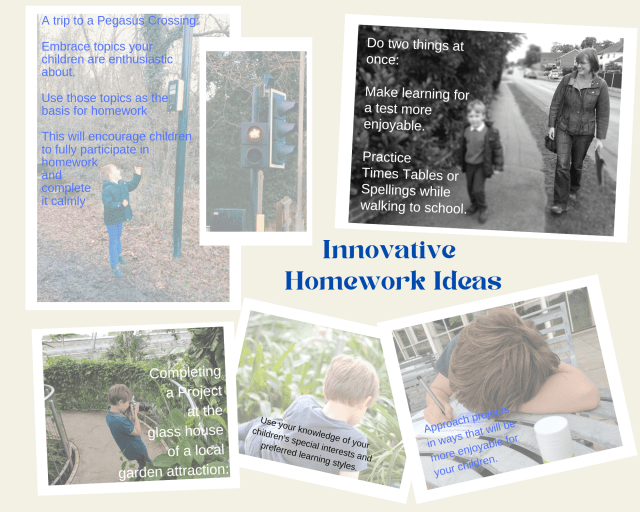
10. Use Your Imagination to Make Homework More Fun, If necessary, Complete it in an Innovative Way
You do not need to feel hemmed in by the exact wording of the homework task. Having identified the learning objective of the task, you can invent your own ways of doing the homework, to enable your child to complete it more calmly.
Here are some suggestions of how you can make a homework task more fun to complete:
- You can change the location of where your child completes their homework.
- They can sit on the floor.
- They can complete it while walking.
- They can sit in the garden.
- You can all go out and about on a family day trip and incorporate the homework into that trip.
- Your child does not have to write or draw on paper and does not have to use traditional pens, pencils, paints or art materials to complete their homework.
- They can write their homework on a big whiteboard or blackboard using erasable markers or chalk.
- They can take a photograph of a chosen subject and then verbally describe to you why they have taken that photograph in completion of their homework.
- They can draw their art homework on the patio using chalk.
- They can do big paint splatters on a very large piece of paper spread out on the floor in the garden.
- You can amend the homework topic to include your child’s special interests (see examples below of how we have incorporated our son’s special interests into his homework at times).
You as the parent can submit any pieces of this innovative homework to the teacher by taking photographs of the homework and, either printing them out and sticking them in your child’s book, or emailing the digital file to the teacher.
Similarly, any verbal explanations spoken to you by your child can be recorded and the audio file sent to the teacher, or you can email the teacher with a written account, transcribed by you, of what your child shared with you verbally during the homework session.
As long as the learning purpose or learning objective is achieved, you can give yourself the freedom to do things differently if it helps your child.
Try not to be fearful of what the teacher might think. The teacher should be pleased if they can see your child has spent time completing the homework and has practiced or learned something towards the learning objective that the task was designed to achieve.
If the teacher feels your child has met their expectations for the homework, your child has enjoyed the process of completing the task and learned something relevant from completing it, that can be marked up as a successful homework and learning experience!!
Here are some specific examples of how we have used innovative methods to complete homework:
Reading Homework
On occasions when our son has become reluctant to read at home, we have used the following ways to make reading more appealing to him: –
- We have abandoned the book he has brought home from school and read an alternative book from home instead.
- If the book he is asked to read is more appealing to him he is much more likely to read calmly.
- Sometimes, when our son was feeling generally anxious about school, simply reading a book that did not remind him of school made it easier for him to concentrate on reading.
- We have taken it in turns, alternating between the parent and our son, to read one sentence or one page each.
- We have simply read to him on a particular night and he has followed along with the page and listened.
- We have also helped our son finish reading a book that he felt anxious about by telling him how the book ends. This reassured him that he did not need to feel worried, scared or sad about what might happen during the story.
- We have sat with our son and watched the film version of a well-known story, or listened to an audiobook. Having seen or heard the story in advance, he was able to concentrate better on reading the book without worrying about how the story ends.
These methods are particularly helpful to try when your child needs encouragement to feel like they are making progress through a particularly tricky book.
Your child can often feel this way when they are transitioning from shorter picture books with a few large words on each page to chapter books with many more words on each page.
Taking the pressure off sometimes, so that children can get involved in a way that feels good to them, and giving them permission to “just do a little bit” can build their confidence. It can encourage them to take part in regular reading homework, even when they are finding it more challenging.
In relation to the idea of allowing them to find out the ending of the book, I would recommend using this approach cautiously and rarely, so as not to let it become an ingrained habit.
If used, I would recommend using it as a learning opportunity to explain that it is normal and healthy to feel a range of emotions when reading or watching films.
Try to reassure them that reading is a good and safe way to experience situations and emotions that they may not have experienced in their own life. Try to encourage them that experiencing a full range of emotions is a good thing.
It is also important to remember to record these reading sessions accurately and honestly in the homework diary. The teacher needs to know what you have done during that reading session so they can fully understand how much of the book your child actually read for themselves.
Having completed an alternative reading experience on any particular evening, it is important to have a plan about how you will get back to normal reading sessions as soon as possible.
The next night (or after an appropriate period) you will need to try to return to reading the school book in the normal way. If unsuccessful at returning to the school book, you can investigate the reasons why your child is reluctant to do so and discuss any hurdles with the teacher as necessary.
Doing Two Things at Once to Ease Anxiety
Above, I have already mentioned how we used visual aids or “posters” around the house to help our son learn Spellings and Times Tables when preparing for tests.
This is the first example of how you can use the method of allowing your child to do two things at once to help them feel calmer while learning and completing homework tasks.
In this visual aid example, our son looked at the “poster” multiple times throughout the week.
By looking at the “poster” and remembering the information on it, he was mentally completing his homework.
At the same time as looking at the “poster”, he was usually doing something else as well. This was normally a physical task unrelated to school. For example, he might be eating his breakfast, playing with his toys or getting his coat and shoes on ready to leave the house.
This method of doing something physical at the same time as practicing for a test has definitely proved to be a successful method to ease pre-test anxiety for our son. Having realised this, we chose to introduce a follow up activity designed to check his learning which was based on the same principle of doing two things at once.
Before the test at the end of the week, we chose a morning while walking to school to check his learning. I took a piece of paper in my pocket which contained the words or Times Tables he needed to know for the test.
As we walked, I read out the words he should have learned or asked him various Times Table calculations that he needed to know. He verbally spelled out the word or told me the answers. Most of the time he got them right. If not, I simply told him the correct spelling or answer and hoped he would remember it for the test.
I believe this method worked for our son for two reasons:
- The physical task made him feel more relaxed and distracted him from any anxiety he had about school or the test. It therefore helped him to concentrate without becoming distracted. This meant that he was more likely to successfully learn the information he needed for the test. This built his confidence and self-esteem.
- By doing something else simultaneously that either needed to be done (e.g. walking to school), or that he enjoyed (e.g. playing with his toys), he did not feel as if homework was taking up his precious free time. Therefore, he did not become frustrated or angry about having the work to do. This also helped him to remain calm and focused.
You can be imaginative about how you incorporate this idea of doing two things at once into your routine. There are lots of different things you can try:
- You can push your child on a swing while praciticing their spellings.
- You could practice Times Tables while traveling in the car or on a bus.
- Your child can bounce on a trampoline while they are tested on their phonic sounds.
- You can recite Times Tables while feeding the ducks together.
The list is endless. You know your child best and will be able to pick the best activity for your child to combine with their learning.
Completing Big Overwhelming Projects with Ease by Planning Something Fun and Incorporating Your Childs Specific Interests and Preferred Learning Styles
Here are two examples of occasions when we completed homework projects using fun plans that played into our son’s special interests and preferred learning styles.
A Drive to See a Special Kind of Push Button Controlled Road Crossing
When our son was in the very early days of school, during his Reception year, the school gave him a Home Learning exercise book. For homework, he was asked to record something of interest in that book once a week.
It was suggested he could write about something he had done in his spare time, write about something he had read, practice his handwriting or perhaps draw a picture.
We did not always find it easy to complete any of these open-ended tasks with him.
On one occasion we used a request he made to us as the basis for a piece of homework. It enabled him to complete and submit a piece of homework calmly.
At school, he had enjoyed a lesson where the teacher talked about various pieces of road traffic furniture, road signs and road crossings. During that lesson, the teacher showed them a photograph of a rare kind of push-button road crossing called a Pegasus Crossing (also known as an Equestrian Crossing).
This type of crossing assists those riding horses along bridleways to cross the road without having to dismount their horse. The unique features of this crossing are that the button is much higher up on the pole to enable the horserider to reach the button while sitting in the saddle. The Red, Amber and Green lights shown to the traffic are in the shape of a horse and its rider. This alerts the traffic that a horse is crossing the road.
Our son remembered seeing one of these crossings locally (we were not aware of it and he had to describe its location to us!). He wanted to visit it and take a look at it.
Our son has always been very interested in vehicles, road transport and buttons, so we took him there to see it.
We looked at its location, showed him what a bridleway is and examined the special features of a Pegasus Crossing close up.
We took photos of our trip. One photo showed our son jumping in the air to try and reach the really high up button.
We printed out the photos and stuck them in his home learning book for his weekly homework.
We, as the parents, wrote an explanation for the teacher explaining that the reason we had visited the crossing was because our son had enjoyed the lesson at school, especially the photo of the Pegasus Crossing he had been shown. We explained he had identified for himself a local real life example of the crossing to visit.
Our son was fully enthusiastic about this homework and took a full active roll in it. He guided us to the location, he posed for photographs and talked to us about the special features of the crossing.
He was able to take part in the homework and have something to submit to his teacher without having to do any handwriting or drawing at a desk. It was the perfect kind of learning activity for him.
The teacher was really pleased to see it because it showed that the lesson in school had been effective and sparked his enthusiasm for further learning.
Completing a Project at a Nearby Garden Attraction: The Topic for the Project was Chosen to Play Into Our Son’s Special Interests
When our son was a few years into his time at Primary School, his class was learning about the animals and plants that can be found in different habitats around the world. He was set a project to research and write about the plants in a habitat of his choice.
Our son is not particularly interested in animals, flowers or nature in general. He prefers machines, vehicles, and exploring towns and cities. Therefore, he was not particularly interested in the topic of this project, which was going to be quite a time-consuming piece of homework.
We used our system (as described at Idea Number 5 in Part 4 of this series) and set aside a separate time to choose his project topic. This enabled our son to focus entirely on deciding which habitat he would choose to study. When discussing this choice it helped that we knew what his special interests were and what his preferred learning styles are.
We were able to assist him in choosing the Tropical Rainforest as the topic for his project. We knew that he enjoyed visiting a local garden attraction that had its own glass house containing tropical plants.
We knew that he would enjoy completing the project more if he knew that doing the project would allow him to enjoy a bonus day out and if he could actually do the research and writing for the project while out and about.
We also knew that by choosing the Tropical Rainforest as his topic he would be able to do a lot of research in the glass house. He enjoyed the glass house because of the technology it contained. It had automatic doors, a lift to go between the two floors of the glass house, there were sprinklers, automatic misting machines to keep the humidity up, temperature regulation machines, thermometers and other technology that were all necessary to keep the tropical plants alive in this country.
We knew that he would legitimately be able to write about how this technology was used in the glass house to mimic the habitat of a tropical rainforest. This would spark his interest in completing the project. He could enjoy the project even though, on the face of it, the topic was not of interest to him at all.
We planned a day out to the garden and the glass house. As an extra incentive, his Dad gave him permission to use a camera with a big zoom lens to take photos of any selected plants and technology that he wished to include in his project. We agreed we would eat at the cafe there and he would be given the time to write up his research during the day out so that by the time we came home afterwards he would have finished his project (apart from printing out and adding his photographs to the finished piece of work).
We all had a lovely day out. Our son took lots of photos and did some really good writing about the tropical plants and the glass house technology he learned about.
When he handed in his completed project he was really proud of it. To this day he still sometimes asks us if we remember the time we did his project at the garden attraction. He remembers it fondly.
I think we can safely say this was a positive learning experience for him.
A positive bonus was that his teacher gave him really positive feedback for his effort and work on the project. At a parent consultation his teacher specifically mentioned to us what a wonderful project they thought it was.
This just goes to show it is possible to make homework calmer, easier and more enjoyable for all the family AND still more than meet the teacher’s expectations for a piece of homework.
Finally, I would just like to make it clear that we are not aiming for perfection. You are never going to come up with a perfect system that works perfectly for every homework session. Children are never going to complete every single piece of homework happily with a smile on their faces!!. There is no such thing as perfection.
There are always going to be ups and downs and various wobbles along the way. Teach yourself to expect things to go wrong sometimes and you will find you cope with those difficult times better than you did before.
We want to teach our children that mistakes are not bad, mistakes are a learning opportunity. So, we need to model that for them. If a homework session does not go well, use it as an opportunity to reflect and learn so that you can do things differently next time.
Also, do not expect the same routines and systems to work term after term or year after year. Your child is growing, changing and maturing all the time. As they get older, your routines and systems will need to grow with them.
If you start to feel like homework sessions are regularly not going so well, it may be time to review your approach and see if your routines and systems need to change in order to move with the times.
More importantly, please remember that not every problem can be solved by an individual on their own. Some situations cannot be improved by solely making changes within the family home.
Please don’t struggle in silence. Sometimes we need to ask for help from experts and seek support from others outside of the home. I know it can be hard, but I think learning when it is time to ask for help is an extremely good skill to practice.
There might come a time when you have tried everything you can think of and homework is still a struggle. In those circumstances, seek out help from the teacher and the school. Perhaps your school runs a homework club that your child could attend. Perhaps you could make some inquiries to see if there are any parent groups to join for the support and friendships of others.
When my son was young, me and another parent supported each other. My friend encouraged me to attend a weekly parent group for companionship and discussion. I helped my friend by printing out worksheets and resources for homework tasks because she did not have a printer. Just talking to others who were at the same stage of life and sharing ideas was so helpful and so calming.
Also, do not assume that your family alone is struggling with homework. Once you open up and talk to others from your child’s class and school you may be surprised to find that lots of families are finding the completion of homework difficult. There may be a structural problem with how the homework is being set that is leading to lots of children suffering under the strain.
You should not force yourself or your child to conform to a homework schedule that is unreasonable or unrealistic. If pretty much everyone is struggling with the homework regime you may be able to join together as a group of parents to speak to the school about the effects the homework is having on your children.
Teachers and parents may be able to work together to work out how the homework structure can be improved. The school and teachers will not want their homework schedule to be having a negative impact on their students, but if no one tells them they will never know the true impact.
We can feel so much stronger if we work together with others instead of remaining isolated. It is for that reason that I would like to create a space here for parents to share their comments and ideas about how best to calmly complete homework. We may be able to help each other if we share good ideas that we have learned.
If you have tried any of the ideas I have shared with you here in this series (or have any new ideas that you think would be helpful to others), I would love to hear all about your experiences in the comments below.
Good Luck with it all and be kind to yourselves!!
Clare
Whilst reading this series, please bear in mind that I am not an expert in education or home learning. What I share here is simply based on my own experiences with my own family (along with some very helpful advice from my dad who was a teacher).
If in doubt, I would always recommend liaising with your own child’s teacher and school or another qualified professional.
Resources
Book
Essentialism, The Disciplined Pursuit of Less by Greg McKeown, 2014 (Ebury, Penguin Randomhouse Group) – Please see Part 1 & Part 2 of this Blog Series for a full explanation of how I found this book helpful when designing a calm approach to homework
Follow Me on Instagram
(You’ll find me @its_calmwithclare)
Click the Instagram link below to visit My Profile page and discover Posts, Reels and Stories about all things calm. I generally post each week on themes relating to the “Featured Post” on this blog*.
Follow Me on Pinterest
(You’ll find me @calmwithclare)
If you would like more inspiration and to explore a variety of resources about children, homework and school you may wish to click the Pinterest link below and take a look at my Saved Pinterest Boards “Calm Words for Kids” and “Back to School“.
I would love for you to join me on Instagram and Pinterest.
*Please visit this blog’s About page to find details of this week’s featured post.
 Creating Calm with Clare