
Calm Parent – Calm Child
Please Note The information included in this blog post was originally published (in 2022/2023) as part of a two-part series. I am now re-blogging it as part of a 6-Part series to ensure ease of reference for the reader.
This blog post is Part 5 of a 6-Part series about how you can calmly complete homework with your young children.
In this blog post, we will be discussing how you can gain clarity about the nature of the task set by the teacher. Namely, whether the task is “Time Limited” or “Task Limited” and understanding the Learning Objective behind the task.
We will also consider how you can identify your child’s favourite subjects and their preferred learning style. You can then learn how to use your knowledge of their preferences to your advantage when approaching homework.
For interested readers, and to put this post’s topics into context, I have included an overview of the whole Calm Homework Series in the next section below.
If you prefer, you can scroll past this “Overview Section” and skip straight to this post’s topic which focuses on clarifying a homework task’s requirements and fully understanding children’s learning preferences.
Overview and Summary of This Calm Homework Series
In Part 1 of this series, we discussed how to create a “Good Homework Culture” in your home in preparation for the calm completion of homework tasks.
In Part 2 we considered an overview of 10 Practical Ideas that can help with the completion of individual pieces of homework. We looked in detail at how familiarising yourself with the school’s expectations for homework is an important and very helpful step towards becoming thoroughly prepared for supervising homework.
In Part 3 we considered how you can identify the best time of day and the best days each week to do homework with your children. We also discussed how you can prepare your home environment for each homework session.
In Part 4 we considered how you can mentally prepare yourself, as the supervising parent, for each homework session. We will also discussed how to reduce anxiety for your children by separating the process of choosing which task to do from actually completing the task.
If you have not yet read the first four parts of this series, I would highly recommend taking the time to visit and read them before continuing with this post. Reading the series as a whole will help you to get the full benefit from the practical ideas contained in this post (Click Here for Part 1).
For ease of reference, here is a summary of the 10 practical ideas that I discuss throughout this series along with links to each part. Please note, the ideas listed in bold text (Ideas 6 and 5) are the subjects I will be discussing in this blog post: –
- Familiarise yourself with the school’s expectations for homework (Part 2).
- Identify the best time of day and the best days each week to do homework with your child (Part 3).
- Prepare your home environment for each homework session (Part 3).
- Mentally prepare yourself for each homework session (Part 4).
- Reduce anxiety by separating the process of choosing which task to do from actually completing the task (Part 4).
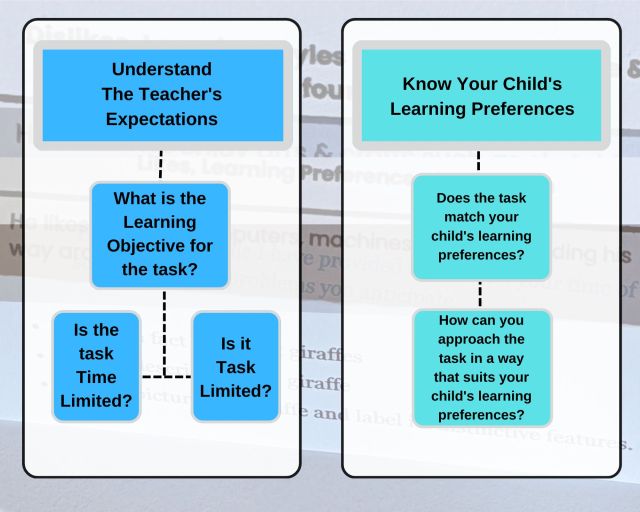
- Be clear as to whether the task is “Time Limited” or “Task Limited” (Read on Below).
- Identify your child’s favourite subjects and their preferred learning style. Use your knowledge of their preferences to your advantage when approaching homework (Read on Below).
- Identify the underlying learning purpose (or learning objective) behind the task and be clear about what the teacher wants your child to learn before starting the task (Read on Below).
- If you think it will be helpful to prepare some modified resources to help your child complete their homework more independently, get those resources organised before you and your child sit down at the homework table (Part 6).
- Use your imagination to make things more fun, if necessary, by completing the homework in an innovative way (Part 6).
Practical Ideas 6, 7 & 8 – Clarify What the Task Requires and Know Your Child’s Learning Preferences
Be Clear as to Whether the Task is “Time-Limited” or “Task-Limited”
We have already introduced the idea of Time-Limited versus Task-limited homework in the section about fully understanding the school’s homework expectations (See Part 2).
As a reminder, here is a summary of the difference:
Some homework instructions will ask your child to spend a specific amount of time (e.g. half an hour) on a homework activity. This is a Time Limited Task.
Some homework will be set with the intention of a specific task being completed during the homework session, with no reference to the amount of time it should take. This is a Task Limited homework.
You, as the parent, need to be clear about which kind of homework has been set so that you can encourage your child to be content to stop at the appropriate time.
If it is a Time Limited homework, they should feel content to stop at the end of the allotted time period, whether they have finished everything that was set or not.
If it is Task Limited, they should feel content to stop as soon as they have completed that task, even if they do not feel like it took them very long.
Here is an example of a Time Limited Homework:
If reading is a Time Limited task that needs to be completed three times a week, your child could read 1 page of their book each night for three nights (a total of 3 pages) because that is the appropriate amount of reading for their ability, attention span and wellbeing. In doing so, they will have met the school’s expectations.
Another child could read one whole book each night for three nights (a total of 3 whole books) because they love to read for long periods of time and have mastered the skill of reading quickly. They will also have met the school’s homework expectations.
It is the frequency, consistency and process of practicing reading that is important, not the number of pages or books read.
Recognising a task as Time Limited and learning to stop when the allotted time is up is an important skill to master. It will be a useful skill for your child to carry into adulthood. It will prepare them for being successful at time management and I believe it will be good for building their self-esteem.
Stopping their reading after the appropriate time period and before finishing a whole page, chapter or book will help them to fight any tendencies they might have to fall into non-beneficial habits. It will guard against learning perfectionist habits or over-performing to please others for fear of being judged for not doing enough.
It will teach them that they are good enough just as they are. They can concentrate on their own learning journey and achievements. They will learn that they do not need to compare themselves to others.
Here is an example of a “Task Limited” homework:
The teacher has set 10 maths sums to complete. The expectation is that your child will attempt to answer all 10 questions during the homework session. No timeframe for completing the task has been given by the teacher.
Your child may take a whole hour to solve the 10 maths questions and complete the homework. They may struggle through the questions and fear that they are unable to do it. They will not have met the homework expectations (as set by the teacher) until they have attempted all 10 questions.
Another child may take 5 minutes to complete all ten questions set because maths is their favourite subject and they have successfully mastered the art of solving maths problems quickly. They will have met the teacher’s expectations even though it only took them 5 minutes. This student does not need to look for extra work to do to “fill up” time.
The task set was about completing a certain number of maths problems it was not about spending a certain length of time practicing and studying.
Completing the task “as set” can teach your child to be resilient and persist at a task for longer, even if they are completing it more slowly or finding it difficult. It can help them to learn to expand their attention span.
On the flip side, if your child found they were able to finish the task quickly, they can feel proud of their achievement and feel content that they have more time to go off and do something else. They can also learn that completing the task as set is enough. They do not need to look for more work to do, over-perform or unnecessarily spend more time on something just to impress the teacher or others.
Sometimes homework sessions will be short and that is fine, other times the homework will take longer and that is fine too.
That being said, nothing prevents you as the supervising parent from introducing your own time limit on certain tasks if you feel it is appropriate to motivate your child to participate in the homework.
Even if the task has been set as a “Task Limited” homework and the teacher has not stated a time limit in the instructions, if you feel that limiting the amount of time you are prepared to spend on a task will be helpful to your child, then you as the parent can feel free to set that time limit for yourself.
This is especially the case if your child is really struggling with the task and expressing negative comments about themselves or about being a “failure” or “useless”. If homework has reached that stage, it is no longer a positive learning experience and you can feel free to encourage your child to do their best on just a few questions within a certain time limit and leave the rest undone.
If you complete the homework in this way, you can simply put a note on your child’s homework for the teacher to read. You can tell the teacher that your child spent over an hour trying to complete the questions and managed to complete 5 within that time period. You can suggest to the teacher that they may need to revisit the topic with your child to help them feel more confident in solving such maths problems.
If your child feels worried about stopping, explain to them that when learning it is just as important to find out what they do not know as it is to find out what they do know. Explain to your child that it is important for the teacher to fully understand what topics your child is still in the process of learning. The teacher can then design lessons to teach them helpful information during future lessons.
Explain to your child that the teacher will be pleased that they tried their best during the homework session and that they are honestly communicating with the teacher about what they still need to learn.
I hope this discussion about the differences between Time Limited and Task Limited homework reassures you that you can come up with an approach to complete homework tasks calmly, regardless of the nature of the homework set.
You can also use your knowledge of the differing nature of certain tasks to ensure that you efficiently focus your child’s attention on the most important things during the homework session. Ultimately, this should hopefully lead to your child enjoying a better learning experience and probably spending less time and energy on doing homework overall.
Identify Your Child’s Favourite Subjects and Their Preferred Learning Style. Use Your Knowledge of Their Preferences to Your Advantage When Approaching Homework
Each child is unique. Not all children enjoy the same activities. While the teacher will obviously try their best to set work that is appropriate for the whole class to enjoy, they cannot please everybody all of the time.
Your child is not going to like all of the subjects and tasks they are faced with at school equally. In fact, there are likely to be some subjects and tasks that they actively dislike.
Your child will take some activities in their stride and struggle with others.
How does the saying go? “Don’t try to fit a square peg into a round hole”. Sometimes struggling to complete a piece of homework with your child can feel like you are trying to do exactly that!!
We discovered that we enjoyed calmer homework sessions if we tried to ease any mismatch between:
- The nature and topics of the homework set by the school, and
- My son’s actual interests, favourite subjects and preferred ways of doing things.
We did this by taking account of my son’s interests and preferred learning styles and using that knowledge to approach all homework tasks in the most advantageous way.
In other words, we would try to design homework sessions to play to his strengths and interests. We would minimise the aspects of the homework task that were difficult for him or less interesting to him.
We found that when my son was really interested in a topic or found joy in the process of completing something, he was much more motivated to take part in it and complete it calmly.
Playing to his strengths, preferences and personal interests was the key to motivating him and helping him to overcome his fears. Overall, it leads to a better learning experience for him.
I have provided some examples of this approach earlier in this blog series. For example, in Part 4 when writing about Idea 4 (Mentally Preparing Yourself as the Parent for a Homework Session) I mentioned how I prepared for homework that involved handwriting by making some amended resources to overcome my son’s fear of making a mistake on a worksheet and allow him more space to write in bigger letters (Click Here to read more about this in Part 4).
In order for me to be able to make those preparations I needed to have a detailed understanding of my son’s preferred learning style and his preferences. I knew that he liked to hand in a well-crafted final piece of homework to his teacher. I knew that he was not confident in his handwriting ability and did not enjoy the task of completing handwriting.
I also knew that he gets frustrated when writing because he has lots of ideas and a good imagination. His answers and ideas come to him quickly. When he is writing his pen cannot keep up with the speed of his thoughts. So, quite often the result he sees on the written page when he has finished does not match up to the thoughts he originally had in his head. This leads to him being dissatisfied with his final piece of work.
I am also aware that he knows that he is very good at correctly spelling words. However, he does not always feel that he has demonstrated that ability to the teacher in his piece of work because, if his handwriting becomes too messy, it is difficult to see if the word is spelled correctly or not.
From all of this, we can conclude that our son enjoys “creative writing” but would rather tell the story verbally than write it down. He is proud of his ability to spell words correctly but would rather practice and be tested on his spellings by the words being read out to him and him verbally telling you the answers out loud, rather than writing answers on a piece of paper.
This knowledge guides us in the planning of our homework sessions. In addition to providing extra copies or amending worksheets to overcome our son’s fears about failing at his handwriting, we can also use our additional knowledge about his learning preferences when designing our approach to the homework session.
For example, if it is a free writing or creative writing exercise we can design the homework session so that we make time to sit and listen to him verbally tell us his answers before he commits pen to paper.
This allows a large part of the homework session to be enjoyable for him. He can enthusiastically concentrate on expressing his many ideas, without worrying about writing them down in neat handwriting.
Once he has gotten all of his ideas out of his head, we can help him to discuss which of those ideas are the most important ideas and words to write down on the page. This discussion process minimises the amount he chooses to write about as his final answer or finished story.
This means that, by the time he starts writing, he knows he has fewer words to write. The handwriting part of the task does not feel so overwhelming to him and he feels more motivated to commit pen to paper.
This process allows him the enjoyment of sharing his ideas verbally, which he loves to do. Alongside that, it lessens the amount of handwriting he has to do, which pleases him greatly.
In addition, because he has planned the words to write on the page in advance of starting his writing, he is more content with the finished product. This is because what he sees on the page when he has finished closely matches what he hoped to write. There is no longer a vast mismatch between what was in his mind and what he managed to put on paper.
This process also allows us to discuss which words he would like to demonstrate to the teacher that he can spell correctly. The process allows him to verbally tell us the correct spelling of those words he would like to highlight his ability on through his writing. We are then able to talk about how he can write the necessary letters clearly and take his time on those particular words when writing them out.
He can take time and concentrate on those particular words when he writes so that he can show the teacher clearly that he knows the correct order of letters in those words. Knowing that he is only focusing on writing certain words extra neatly encourages him to focus his attention, slow down and really try, rather than becoming frustrated and giving up.
All of these factors mean that at the end of the homework session, he feels happy that he has completed a well-crafted piece of work for his teacher. He can, therefore, leave the homework session content. He is happy and is not worried about the standard of the piece of homework he will hand in at school.
It is important to note that a different child may have different learning preferences. They may not like coming up with ideas and may feel stressed about sharing their ideas out loud in front of people. They may prefer to write their answers on paper straight away in private.
This other child may get the most joy out of the process of crafting beautiful handwriting neatly on the page. For them it might be coming up with an idea or feeling like spelling words is not their strength that feels stressful.
This child would, therefore, want to spend more time physically writing and would need the most support early on to encourage them to swiftly come up with enough ideas to answer the question and then move as quickly as possible onto neatly writing it down. They may need support to feel confident to approach spelling new words so that their fear of spelling words does not interfere with their joy of writing in beautifully neat handwriting.
My son would spend most of the time during the homework session thinking and talking. He would spend the shortest amount of time reasonably possible on the task of actually physically writing it down.
The other child, with different preferences, would spend the shortest time possible coming up with enough ideas and thinking about how to spell the necessary words. They would spend the large majority of their time enjoyably creating neat handwriting on the page.
You can see how knowing your child’s preferences in detail can help you come up with a unique approach to a homework task which will help them as an individual to both enjoy a homework session and meet the teacher’s expectations, even if it includes subjects and tasks that they do not really enjoy.
I would recommend that you take some time to make a note of the things that you know about your child’s learning style.
You can consider questions such as:
- Does your child like to read or write?
- Do they enjoy art, singing, sciences or something else entirely?
- Is your child a visual learner who learns best by watching?
- Are they an audio learner who learns best by listening?
- Are they an active learner who learns best by “doing and getting involved”?
- Are they a passive learner who likes to stand back and take it all in from afar?
- Do you notice any other patterns in their learning?
Consider which school subjects they particularly like or dislike. Think about what they choose to do in their spare time and what activities they really do not like to take part in, if they are given the choice.
Make a note of the skills they are good at or that come easily to them. Also, note down those which they find more difficult or less interesting.
All of this is valuable knowledge that you can use to match homework sessions to your unique child’s preferences, strengths, interests and preferred learning styles.
A useful method for recording your thoughts about your child’s learning styles is to make a chart formed of two lists. Below, I have provided an example of a chart I have made about my son’s preferred learning styles which might be useful for reference when designing your own.
| Likes, Learning Preferences & Strengths | Dislikes, Learning Styles that do not resonate & tasks that are found more difficult |
|---|---|
| He likes science, computers, machines, transport, finding his way around & maps. | He does not enjoy arts & crafts such as sketching, painting or colouring. |
| He enjoys talking and conversation. | He does not like taking part in an activity that he does not understand or feels that he does not know how to do. So, he does not like to learn by doing repetitive tasks such as writing out words on the page to learn how to spell them or writing out his timetables. |
| He has a good memory for facts & skills that he is taught. | He finds practicing or revising makes him anxious about the test to come. |
| He can read really well (at quite some speed). | He does not enjoy handwriting. |
| He is a visual & audio learner. So, he likes to learn by looking, reading, watching & listening. For example, he likes to learn things such as spellings & times tables “in his head” by reading or looking at them in private & then being tested on them verbally (normally just once!) to check his learning. He likes to learn first & only then do or take part. | He does not like to feel like he is being tested at his times tables or spellings because he may refuse to give an answer for fear of getting it wrong. |
| He is good at mental arithmetic & understanding money (how much to pay, the required change, etc). He can give swift correct verbal answers to simple arithmetic questions. | He does not like solving written maths problems & maths tests make him anxious. Maths makes him particularly anxious about committing answers to paper for fear of getting the wrong answer. |
| He likes to put his ideas on paper by designing things such as diagrams, maps or action scenes made up of “outline-only” black & white line drawings. | He does not think he has the skill or patience to make a “pretty piece” of art. He does not like spending time colouring things in. |
| He likes music. | He does not like to perform with people watching him. Therefore, he does not enjoy taking part in a concert or celebrating his achievements by going up the front in a school assembly. |
| He likes being out and about experiencing things. He is more relaxed out and about. He learns a lot from experiencing the outside world firsthand. | He does not like to feel like he is wasting his time doing things he does not enjoy when he could be out-and-about instead. |
| He likes doing real things such as using cash points, grocery shopping, taking the bus/ train and ordering food at a restaurant. | He does not enjoy sitting at a desk indoors for long periods of time. |
| He likes role-play: acting out things such as going to shopping centres or creating a machine with his friends or classmates. | He does not enjoy following instructions to build Lego or playing with toys he believes are childish, loud or unpredictable. |
| He likes to use computers and technology to carry out activities that align with his interests. | He does not really enjoy feature films, cinema, theatre or TV in general, especially if he feels uneasy about any surprises that might happen, uncertain about how it will end or concerned about what emotions might arise. |
Some people might think that using this approach is somehow “spoiling” your child by allowing them to only engage in things they are good at or enjoy and allowing them to avoid facing up to difficult tasks. I would argue that this approach achieves the exact opposite of that.
From the description I have provided, you will see that even though my son really does not enjoy handwriting, our approach does not enable him to avoid practicing the skill of handwriting altogether. Our approach still requires him to do the handwriting for the teacher.
Rather than helping him to avoid tasks he does not like or feels he is weak at, our approach encourages him to look at the whole task overall and then break it down into a number of different parts. He will learn to see that he does like certain parts of the task and does not like other parts of the task.
This teaches him to enjoy parts of any given task even if he does not like other parts of it. It teaches him to be flexible, inventive and resilient. He is learning to persist and calmly come up with ways to “get through” the parts of any task that he does not like.
This process allows him to gain more enjoyment from the task as a whole, while also meeting the teacher’s expectations.
I believe, in the long run, modeling how to be flexible with tasks in this way will be helpful in showing your child how to avoid “black and white” fixed thinking in the future. It will teach your child how to overcome fear and avoidance. It will show your child how to become a resilient student and a resourceful human being.
Identify the Underlying Learning Purpose (or Learning Objective) Behind the Tasks and Be Clear About What the Teacher Wants Your Child to Learn Before Starting the Task
All homework set by the teacher will be set with a particular purpose in mind. The teacher will intend for the children to meet a particular learning objective by completing the homework.
At first sight, the learning objective may not be immediately obvious. So you might need to pause and think about the instructions in more detail before you can identify the learning objective accurately.
Here are some examples of how you might go about identifying it:
Example 1
If we go back to the homework task that I outlined above about giraffes (see previously under idea number 5 in Part 4), you will remember that the children were given the choice of completing the homework in one of three ways. They could either prepare a fact file about giraffes, write a description of a giraffe, or draw a picture of a giraffe and label its distinctive features.
The children only had to complete one of these tasks and were given a free choice of which one to choose. Therefore, it is clear that the central learning objective for this task is NOT to improve their drawing or art skills. Also, the objective is NOT to improve their written or handwriting skills, as not all of the choices given require those particular skills.
On analysis, the common theme of these three tasks becomes clear and it can be concluded that the apparent learning objective of this particular homework is to learn more about giraffes (especially their physical features) and for the children to gain an understanding that knowledge about a topic can be presented in various different ways. Thus, they are given a choice of three equally effective methods of presentation to choose from.
If the homework task had been set differently, it would be clear that the learning objective was something else entirely:
Example 2
The homework task might say, “Choose one of the following three animals: a giraffe; a cat; or a fish. Use your most descriptive and imaginative words to tell me about your chosen animal. Write in your neatest handwriting”.
In this instance, it would be clear that the learning objective was not necessarily to learn facts about any particular animal. Instead, it is a task where the learning objective is to improve the children’s written work by expanding their language and vocabulary skills and practicing their handwriting.
Example 3
Another homework might say, “Draw a picture of one of the following animals: a giraffe; a cat; or a mouse. Use a pencil to sketch your chosen animal’s eyes, nose and tail in detail. Use coloured pencils, felt tip pens or paints to add colour to your artwork and show the texture of the animal’s fur.”
In this example, the objective, once again, is not to learn facts about any particular animal. It is clearly a drawing and art homework about accurately sketching an animal and bringing it to life with colour and artistic skill.
By reading these three examples together you can see how important it is to identify the correct learning objective before you begin the homework with your child. Identifying that objective accurately will prevent you from spending unnecessary time, energy and emotions on parts of the homework that are not really important to the central learning objective of the task.
Below I outline a number of examples to show how this process of identifying the Learning Objective at the outset can inform and benefit you and your child throughout the whole homework session.
How the Learning Objective can guide you to enable your child to complete their homework successfully while minimising the need for your child to engage in skills they dislike or struggle with
In “example 1” above, where the learning objective is clearly to learn about giraffes and is not an art or handwriting homework, you would know that you can find a way for your child to complete that homework, meet the teacher’s expectations and fulfill the learning objective without having to do any handwriting or artwork at all. Therefore, your child does not need to spend any time, energy or emotions during this particular homework session thinking about art or handwriting.
For example, they could choose to prepare a fact file. If they prefer to type on a computer rather than do a handwritten piece of work they could type up the facts they learn about giraffes and print them out to hand in. No handwriting will be required in the completion of the fact file.
Alternatively, they could research facts about giraffes and find photographs of them on the internet or in a book. They could either print out the facts/photos from the internet or photocopy extracts/photos from the book. They could cut out the facts/photos they wish to include and create a fact file by attaching their “cutouts” with glue as a collage on the page for their teacher to see.
Your child could choose the option to describe a giraffe. If your child enjoys verbally using descriptive language but struggles to write it down, they could verbally tell you their description of the giraffe and you could record the audio and submit the audio recording to your teacher. You could email the audio file to the school and send a note to the teacher with your child to guide them toward the email and explain how you have completed the homework.
Alternatively, if they like typing at the computer, they could type up their description and print it out rather than handwriting it.
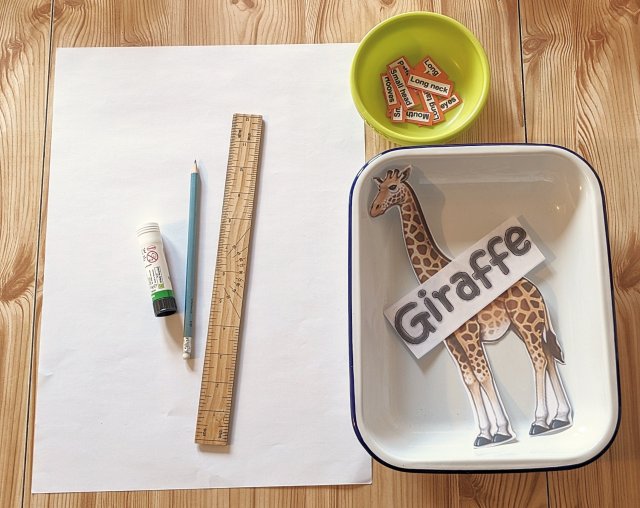
As this is not an art homework, they could still choose the task that asks them to label a picture of a giraffe even if they do not like drawing or writing. The drawing part of the homework is not central to the task so, If they enjoy labeling diagrams, they could search for and print out a picture of a giraffe, or do a dot-to-dot picture of a giraffe, or colour in a colouring page picture of a giraffe.
Once they have created a picture to use, they could create labels for the picture by printing out or photocopying facts about a giraffe from the internet or a book. They could then cut out words from their printouts to use as labels for the giraffe picture. They could stick their labels on with glue and use a ruler to draw a line to the relevant parts of the giraffe picture that the labels relate to.
They will have met the learning objective and met the teacher’s expectations, without having to do any writing or drawing.
With all of the above options, because the learning objective is to learn about giraffes, it is worth remembering the following information. If your child likes learning and researching facts and verbally talking about those facts but does not particularly enjoy putting those facts on paper (whether that be in writing or as a picture), you can balance your time during the homework session to play to your child’s strengths and interests. Perhaps 75% of the time would be spent researching, learning and talking about giraffe facts, while only perhaps 25% of the time would be spent actually creating the physical factual presentation on paper.
This would enable your child to enjoy the homework process more, whilst also meeting the teacher’s expectations and fulfilling the Learning Objective.
How Knowledge of the Learning Objective can help you guide your child simply and smoothly through a piece of homework when the very skill your child dislikes or struggles with IS central to the learning objective
It is worth noting that knowing the learning objective can help you in the reverse situation too.
In a situation where the learning objective is the very skill or subject that your child struggles with or does not enjoy at all, you can still use your knowledge of the learning objective to get the homework done as swiftly and as pain-free as possible by hyper-focusing on meeting that learning objective in the simplest way possible for your child.
We can use “Example 3” above, which is a task with an art learning objective to demonstrate this. If you are faced with a homework task where the learning objective is to improve art skills and your child really finds drawing hard or does not enjoy spending their time doing art activities, you can use your knowledge of the learning objective to help in the following way:
The learning objective does not require you to learn a lot of information about any particular animal. Therefore, the animal you choose to focus on during this homework is not important.
This means you can encourage your child to pick the animal that will have the simplest shapes to draw and requires the least amount of drawing possible. In the example above, I would suggest the mouse would be the simplest animal to draw. You could encourage your child to draw the mouse so that they have the minimum amount of drawing to do and they are more likely to succeed at completing a drawing they are quite pleased with.
They could simply draw a rounded shape with a long thin line for a tail. They could draw a dot for a nose, dots for small eyes and simple lines for whiskers and “stick figure” feet. This is a much simpler task than embarking upon drawing a giraffe!!
You can probably find a simple video, a description or some instructions online or in a book about how to draw the simple outline of a mouse to assist your child if that would help to motivate them.
This approach will hopefully get the drawing done as simply, quickly and as pain-free as possible.
You can make sure that your child concentrates on drawing on the features listed by the teacher in the instructions (eyes, nose and tail) and not worry too much about any other details.
When it comes to adding colour and texture, you can provide your child with the simplest medium to work with that you think is appropriate. In this case, you might choose felt tip pens which will quickly and brightly add colour and texture to the picture in the simplest way. You could provide one colour to do dots for the eyes, one colour to do a dot for the nose and another colour to draw lots of short lines across the body to represent the colour and texture of the fur.
You can also decide whether your child will prefer a big piece of paper (if perhaps they feel more capable of drawing large images), or a small piece of paper to encourage them there is not much drawing to do if they find the idea of filling a big blank piece of paper daunting.
We can use “Example 2” from above to outline an approach you might take if the learning objective for a homework task is to improve writing and handwriting skills and your child does not enjoy handwriting, descriptive language or spelling.
For this example, you can help them to choose which animal to describe carefully and wisely, to make it as simple as possible for them. You can hyper-focus on what descriptive words they are going to use and discuss what they are going to write before they start putting pen to paper. This will mean that when they do start writing they are spending their time and efforts on writing only those specific words that are required to meet the learning objective, meaning they write as few words as possible. Hopefully, this will keep the task as brief and pain-free as possible.
For the task in this example, you could encourage your child to choose the fish to describe. “Fish” is a much simpler word to write and spell than the word giraffe. Also if you show them a picture of a goldfish they can simply describe it as “bright orange”, whereas if they are trying to describe a giraffe they will need to describe the pattern on its fur by using descriptive words for both shapes and colours. The fish only has eyes, a mouth and fins, whereas a giraffe has eyes, nose, mouth, teeth, ears, legs, hooves, and a tail. Also, if you want to describe how the animals move, describing that a fish swims is much simpler than embarking on a description of how a giraffe moves. Describing a giraffe is a much more complicated task. Therefore describing a fish instead will feel much less overwhelming for your child.
Picking a simple animal to describe, discussing what words will need to be used to describe it before your child starts writing and checking they know how to spell the words they want to use in advance will all make the task of handwriting much easier for them once they put pen to paper. Therefore, the homework session overall will hopefully be a much calmer experience.
If you as the parent come to the homework table with a very clear idea for what the learning objective is, you will be much better placed to help guide your child toward these simple solutions and towards meeting the teacher’s expectations in a way that fits in with your child’s interests, preferred skills and preferences. You are, therefore, much more likely to supervise a calm homework session regardless of whether it is a task that your child enjoys or not.
Whatever task it is, your full and detailed knowledge of your child’s preferences (which can be developed in the ways discussed in Idea number 7 above), along with your full and detailed knowledge of the learning objective will be really helpful when planning and navigating the homework session.
You have permission to approach a homework task differently. If it is “not fun” for your child, you can remove a non-essential element that has been added purely “for fun” and complete the task without it
It is important to remember that sometimes the teacher will design a task a certain way to “make it more fun”. For example, at my son’s school they quite often suggested drawing pictures as part of maths homework. This was done because a lot of children do not really enjoy maths but they do enjoy drawing. For most children, making maths visual and colourful while allowing them to take part in an activity they enjoy helped them to understand maths and come to enjoy it. However, this will not work for every child.
If, like my son, your child would rather get on with the maths without drawing, you can find a way for them to meet their maths learning objective for that homework without doing any drawing. This is because normally the drawing that has been added to the task to “make it fun” is not central to achieving the learning objective for the task.
For example, if it is a maths task about using money to pay in a shop, the teacher may ask the children to draw pictures of the coins to show their answers.
This is a maths homework and the learning objective is for them to demonstrate their knowledge of the different values of coins and how you can use a variety of those coins to pay the correct amount of money in a shop. It is not an art homework and the learning objective is not to demonstrate that you are good at accurately drawing coins.
If your child is being deterred from completing their maths homework by having to draw coins, you can get around that by printing out some pictures of coins, cutting them out and providing them to your child to use during their maths homework. They can provide their answers to the question by gluing and sticking the correct coins onto the page for the teacher to review.
Amending the task in this way will enable them to enjoy the maths homework session more. They will have met the teacher;’s expectations and fulfilled the learning objective for the task. Overall, they will have had a positive learning experience instead of a negative one.
If it is clear that an element has been included in any homework task purely to make it “fun” and is clearly not central to the learning objective, you should never be afraid to remove that element from the task for your child and to approach the task in a different way that does not involve that “fun’ element.
When setting any task it is the teacher’s wish to inspire children to enjoy their learning. If you, as the parent, encourage your child to do the homework in a slightly inventive or different way, the teacher will not mind at all as long as your child’s love for the subject and motivation for learning, in general, is increased and the learning objective is met.
What Can you do if the Learning Objective is not clear?
As you can see, fully understanding the learning objective can be a key factor in setting up a successful homework session. So, If the purpose is unclear when the homework is sent home, I would first recommend speaking with your child to see if they have received any additional verbal instructions for the homework that can clarify the objective.
If it remains unclear for both you and your child, I would recommend one of two courses of action as the parent before starting the homework with your child:
- Consult with the teacher and specifically ask them what the learning objective is for that particular piece of homework, or
- Make your own decision about what you think the learning objective is based on the information provided to you and proceed with the homework with that objective as your guide.
If you have had to infer the learning objective for yourself, I would recommend making a note on the homework for the teacher of what you understood the learning objective to be when completing the homework and explain that your child was encouraged by you to complete the homework with that learning objective in mind.
If you do not make a note on the homework itself, I would recommend giving some feedback to the teacher afterwards about any confusion caused by the homework instructions. The whole class will appreciate it if the teacher is able to act upon that feedback so that homework instructions can be clearer for everyone going forward.
The Benefits of this Approach
Once again, some people might argue that this approach is pandering to your child and letting them get away with not doing the tasks they do not like. They might argue that this will hinder your child from progressing with a large variety of learning and prevent them from becoming a well-rounded student.
I would disagree. I believe this approach will nurture your child’s overall love of learning and help them to feel enthusiastic and motivated to fully engage in a good learning experience during homework sessions, whatever the subject, task or skill involved.
If they know that not all homework has to involve handwriting, drawing, spelling or maths (or any other task or subject they may not like or may find challenging), they are much more likely to willingly come to the homework table each week. In time they will hopefully come to realise that they do in fact enjoy some homework tasks and sessions, rather than thinking they hate homework altogether!
They will feel free to enjoy homework tasks that match their interests, learning styles and preferences. At the same time, they will learn from you (by you modeling it for them in the way you set up the homework sessions) how to navigate subjects, tasks and general things in life which you do not enjoy or find more challenging.
When the learning objective is handwriting or art, our son’s homework sessions do require him to produce some handwriting or some art. However, we have designed our homework sessions so that he is only required to use those skills during homework when they are compulsory and essential for his learning. In other tasks, where art or handwriting are voluntary and not central to meeting the learning objective, he does not use those skills and instead concentrates on other skills that he does enjoy and that meet the learning objective in that particular task.
Throughout the course of all of his homework sessions, he engages in all kinds of tasks, subjects and skills. We just ensure he spends the most time using the skills and interests he enjoys. He spends the least time on the others that he finds more difficult or unenjoyable.
In reality, this means he is much more likely to engage and try at his handwriting on the few occasions he does do some. This results in a good learning experience on those few occasions. He probably improves his skills more during those few targeted occasions than he would if he was pressured in less favourable learning experiences to do handwriting more often. Also, his other learning that he does enjoy is allowed to flourish more too. He can enjoy that preferred learning without the fear of his non-preferable tasks standing in the way of his learning. I believe our approach prevents his fears of a few tasks from standing in the way of and hindering his learning of all things. Therefore his learning progress in general benefits.
I hope the explanations and examples I have included in this section demonstrate clearly that spending some time becoming clear about what the learning objective is for each homework session can be extremely worthwhile. The learning objective is a very valuable tool to enable you to have calm homework sessions with your child and help them progress in their learning.

In the final part of this series (Part 6) we discuss preparing modified resources in advance to help your children complete their homework more independently. We consider how you can use your imagination to complete homework in an innovative way to make things more fun.
I also acknowledge that not everything can be improved by individuals alone or by solely making changes within the family home. Sometimes we need to ask for help from experts and seek support from others outside of the home. I provide some examples of how you can seek help and connect with others to avoid struggling alone in silence (Click Here to read Part 6 now).
Whilst reading this series, please bear in mind that I am not an expert in education or home learning. What I share here is simply based on my own experiences with my own family (along with some very helpful advice from my dad who was a teacher).
If in doubt, I would always recommend liaising with your own child’s teacher and school or another qualified professional.
Resources
Book
Essentialism, The Disciplined Pursuit of Less by Greg McKeown, 2014 (Ebury, Penguin Randomhouse Group) – Please see Part 1 & Part 2 of this Blog Series for a full explanation of how I found this book helpful when designing a calm approach to homework
Follow Me on Instagram
(You’ll find me @its_calmwithclare)
Click the Instagram link below to visit My Profile page and discover Posts, Reels and Stories about all things calm. I generally post each week on themes relating to the “Featured Post” on this blog*.
Follow Me on Pinterest
(You’ll find me @calmwithclare)
If you would like more inspiration and to explore a variety of resources about children, homework and school you may wish to click the Pinterest link below and take a look at my Saved Pinterest Boards “Calm Words for Kids” and “Back to School“.
I would love for you to join me on Instagram and Pinterest.
*Please visit this blog’s About page to find details of this week’s featured post.

Visit the About page now to design your reading plan for the blog
 Creating Calm with Clare