
Calm Parent – Calm Child
Please Note The information included in this blog post was originally published (in 2022/2023) as part of a two-part series. I am now re-blogging it as part of a 6-Part series to ensure ease of reference for the reader.
This blog post is Part 4 of a 6-Part series about how you can calmly complete homework with your young children.
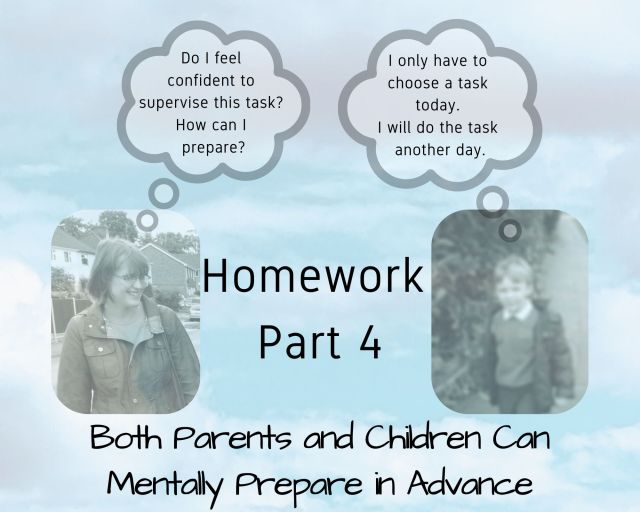
In this blog post, we will consider how you can mentally prepare yourself, as the supervising parent, for each homework session. We will also discuss how you can reduce anxiety for your children by separating the process of choosing which task to do from actually completing the task.
For interested readers, and to put this post’s topics into context, I have included an overview of the whole Calm Homework Series in the next section below.
If you prefer, you can scroll past this “Overview Section” and skip straight to this post’s topic which focuses on mentally preparing yourself for homework sessions and helping your children to mentally prepare in advance for their homework sessions to help reduce anxiety at the homework table.
Overview and Summary of This Calm Homework Series
In Part 1 of this series, we discussed how to create a “Good Homework Culture” in your home in preparation for the calm completion of homework tasks.
In Part 2 we considered an overview of 10 Practical Ideas that can help with the completion of individual pieces of homework. We looked in detail at how familiarising yourself with the school’s expectations for homework is an important and very helpful step towards becoming thoroughly prepared for supervising homework.
In Part 3 we considered how you can identify the best time of day and the best days each week to do homework with your children. We also discussed how you can prepare your home environment for each homework session.
If you have not yet read the first three parts of this series, I would highly recommend taking the time to visit and read them before continuing with this post. Reading the series as a whole will help you to get the full benefit from the practical ideas contained in this post (Click Here for Part 1).
For ease of reference, here is a summary of the 10 practical ideas that I discuss throughout this series along with links to each part. Please note, the ideas listed in bold text (Ideas 4 and 5) are the subjects I will be discussing in this blog post: –
- Familiarise yourself with the school’s expectations for homework (Part 2).
- Identify the best time of day and the best days each week to do homework with your child (Part 3).
- Prepare your home environment for each homework session (Part 3).
- Mentally prepare yourself for each homework session (Read on Below).
- Reduce anxiety by separating the process of choosing which task to do from actually completing the task (Read on Below).
- Be clear as to whether the task is “Time Limited” or “Task Limited” (Part 5).
- Identify your child’s favourite subjects and their preferred learning style. Use your knowledge of their preferences to your advantage when approaching homework (Part 5).
- Identify the underlying learning purpose (or learning objective) behind the task and be clear about what the teacher wants your child to learn before starting the task (Part 5).
- If you think it will be helpful to prepare some modified resources to help your child complete their homework more independently, get those resources organised before you and your child sit down at the homework table (Part 6).
- Use your imagination to make things more fun, if necessary, by completing the homework in an innovative way (Part 6).
Practical Ideas 4 & 5 – Mental Preparations for Yourself and Your Children In Advance of Homework Sessions
Mentally Prepare Yourself for Each Homework Session
As a parent who will be supervising homework, it is important to prepare yourself internally to ensure that you are feeling in the best frame of mind possible to assist with homework tasks.
When preparing your own mind for a homework session, I would recommend looking ahead and finding out in advance what kind of homework you will be supervising at the next homework session.
Once you are aware of the nature of the homework task ahead of you, I would recommend looking back at your previous experiences of helping with that particular kind of homework and being fully honest with yourself about whether you are feeling relaxed and confident about helping with that task or not.
If you know the impending homework is the kind of homework task that your child will most likely enjoy, you will probably feel relaxed and at ease.
If it is the kind of task that you know your child dislikes and such tasks have caused upsets at the homework table before, you will probably feel your energy drop. You are likely to feel tense and worried about how the homework session will go.
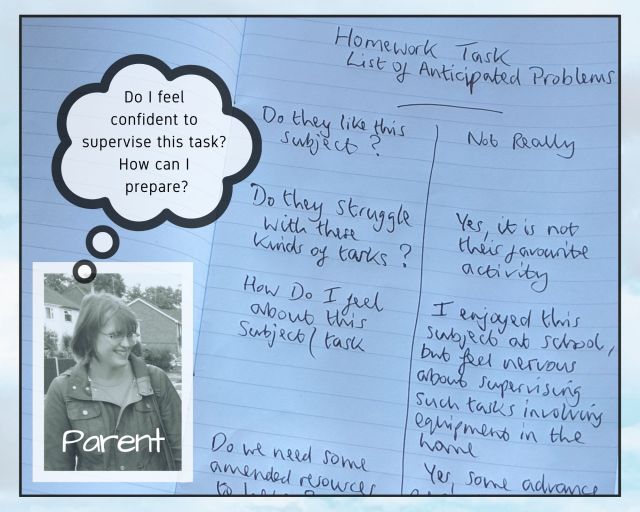
If your past experiences are telling you that this type of homework is likely to be problematic, I would recommend taking some time to consider why that kind of homework causes problems for you and your child.
I would recommend making a list of the kind of problems you can expect might arise. You can then try to come up with some contingencies to overcome those possible difficulties.
My list would include the following factors:
- Is this a school subject that my child dislikes or struggles with?
- Is this the kind of task that my child dislikes or struggles with (e.g. drawing, writing, reading, cutting things out, memorising, making choices etc.)?
- Do I fully understand why my child dislikes or struggles with this subject or task?
- If I do think I know the reason (or various reasons) why my child dislikes that subject/task, what can I do to overcome those dislikes and difficulties within the homework session?
- How can I minimise the elements of the subject/task that my child dislikes or struggles with and maximise our time spent on the more favourable and fun aspects of the task, while still meeting the school’s expectations for that piece of homework?
- Do I need to prepare some amended resources to help us get started on this task?
- Do we need to allow even more time than usual as a buffer to take the pressure off us when completing this task?
- What are my own personal thoughts about this school subject? Is the subject one that I feel confident to help with or is it a subject I myself struggled with or disliked when I was at school?
- Do I enjoy drawing, handwriting, crafts, memorising etc. or are these skills that I rarely use or do not enjoy myself?
- Does the kind of equipment used for this task make me feel nervous? For example, do I feel inexperienced supervising my child while they are using scissors? Do I worry that paint or felt-tip pens will make a terrible mess in the house?
- Would it be helpful to arrange for another adult to be present to help during this homework session? Would it be appropriate to delegate the supervision of this homework session to someone else entirely (if possible)?
If you begin the homework session fully aware of the problems that might arise, these problems will most likely seem less stressful if and when they do arise during the homework session. You will have mentally prepared yourself for the difficulties ahead and will be expecting them.
All being well, having anticipated the likely difficulties you may be able to avoid these difficulties arising altogether. You can plan to approach the homework in a completely different way or you can at least have a plan in place for how to address any difficulties during the session should they arise.
In any event, if the homework session does turn out to be difficult you do not need to give yourself a hard time about it, you predicted it would be one of the harder sessions and were expecting it. This, in itself, should hopefully make the session feel a little easier to deal with.
Below, I will share a personal example of a homework session that I might expect to be a little difficult to navigate. Hopefully reading this example will help you understand how mentally preparing yourself for a homework session can be helpful.
In the early years, my son did not enjoy handwriting. Therefore, if I knew a homework task involved handwriting I was always worried that the homework session would go badly. This was especially so if the homework had been set on a worksheet with only a limited space for the answers.
My son was not confident about his handwriting ability. He always thought he could not write small enough or neatly enough. Therefore, he found worksheets with limited space available particularly stressful. He did not believe he could fit his answer in the space. Also, as he had only been given one copy of the worksheet he believed he only had one chance to “get it right”. This all added to his fears and feelings of stress surrounding handwriting tasks.
When I was faced with supervising these kinds of homework tasks, I myself would feel stressed and anxious. Just thinking about how difficult it would be to encourage my son to complete such a task made me feel tense.
To help me feel more relaxed about the upcoming homework session I would do the following things:
- First of all, I would remind myself that not every homework task needs to be completed perfectly and that we would just do our best.
- I would remind myself to take a few deep breaths before the homework session begins to try and remain calm and relaxed during the session.
- I would think of some alternative ways to complete the homework that might be more appealing to my son and less stressful for him.
Here are some alternative methods for completing a handwriting homework task that I have successfully used for my son’s homework:
- Encouraging my son to write his answers in pencil and providing him with a good quality eraser so he knows he can rub it out and start again if he makes a mistake.
- If I think there is enough space on the worksheet for my son to write his answers in a size of handwriting that feels achievable for him, I simply take a number of photocopies of the worksheet (maybe 5-10 copies) and show my son that there are some spare worksheets available if he makes a mistake. This gives him the confidence to try writing on the worksheet without worrying about “getting it wrong”.
- On occasions where there seems to be insufficient space for him to write his answer on the worksheet, I have encouraged my son to write his answers on a whiteboard with an erasable pen instead. This option allows him write his answers in bigger letters and he can feel reassured that he can rub it out and start again if he is unhappy with his first attempt. Once he is content with his answer and his handwriting, I then take a photograph of the whiteboard containing his final answer and print it out. I mark the worksheet to read “answers completed on a whiteboard, see separate attached sheet for photos of the answers”. I then staple the sheet containing the photographs of his answers to the worksheet provided by the school all ready to be handed in.
- An alternative method, if the worksheet has insufficient space, is to make your own worksheet by cutting up the original worksheet and attaching the questions from the worksheet to a separate piece of paper leaving more space for the answers between each question. On the newly prepared worksheet my son has plenty of room to write his answers.
- Another helpful addition that can be made to an amended worksheet is to stick a wide-lined sheet of writing paper (for big writing) into the enlargened answer space. Alternatively, a piece of specially designed handwriting practice paper can be stuck into the answer space. This helped my son write in a straight line, get his upper and lowercase letters in proportion to each other and make the most of the space available. [Please note, If you are unable to get to the shops to buy this kind of paper, you can go online and print out blank handwriting sheets and ruled sheets of paper to use for this purpose].
If you regularly find that the school materials sent home for homework are causing your child problems (e.g. worksheets with too little space for the answers), I would suggest that it might be worth mentioning this to your child’s teacher. If your child is finding the worksheets difficult, it is quite likely that others in the class are encountering the same difficulties too.
I hope this overview helps you to understand how spending time upfront to consider how you yourself feel about the homework task can be helpful.
I hope the example I have provided shows how your time of contemplation can lead you to practical solutions for the problems you anticipate.
Just knowing that you have these alternative methods of completing the homework ready to present to your child will help you to feel calmer and more composed once it is time to sit down with your child to complete the homework.
Reduce Anxiety by Separating the Process of Choosing which Task to do from Actually Completing the Task
Sometimes teachers send home a piece of homework that includes a choice of which exact task to complete. For example, the children may be learning about giraffes and the teacher may give them the following choices:
- Prepare a fact file about giraffes
- Write a description of a giraffe
- Draw a picture of a giraffe and label its distinctive features.
When my son was young we found that if we sat down to do a piece of homework (unprepared) and my son was faced with a list of choices, this would de-rail the homework session before we even began.
My son wanted to please his teacher, so he would find it difficult to make a choice based on his own preferences because he would be trying to second guess which task the teacher “really wanted him to do”.
Also, seeing tasks listed such as “drawing”, which he did not enjoy, would paralyse him with the fear of having to start drawing a picture immediately and lead to him being indecisive.
Sometimes we would also come to realise that our son did not really understand what some tasks meant. For example, he might not know what a “fact file” was. So, even if that might be his preferred activity due to the skills involved, he would not choose it because he would not understand what he would have to do.
Please be aware he was not always able to vocalise these concerns. We learned, over time, to ask him helpful questions to enable him to make a decision and offer him reassurance along the way.
We would remind our son that you do not always have to understand everything the first time. This would enable us to properly discuss the available choices and what each task would involve. This would help our son come to a decision.
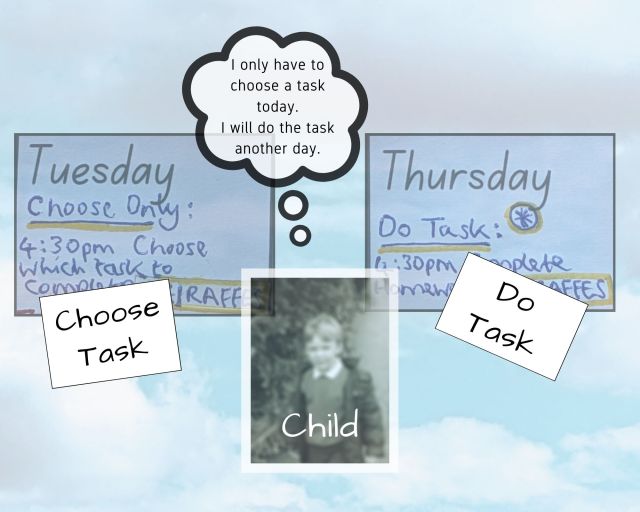
Due to the stress and anxiety caused by having to make a choice we learned to separate the process of choosing the task from the activity of actually completing the task.
As parents, we would take an initial look at our son’s pieces of homework (as soon as they were set) to see if the piece of homework involved making a choice. If our son was required to choose a task we would take the following action:
- Set aside a day and a time purely to complete the process of choosing the task. Ideally, this would be on a completely separate day from the day when the homework would need to be completed. This separation of “choosing the task” from “doing the task” enabled our son to focus completely on the process of making a choice. He could choose without having to worry about any fears or uncertainties he might have about how he would actually complete the task. Any worries he might have about actually completing the task could be saved for another time or another day.
- We would set aside a completely different day or time to actually complete the chosen task. A major practical benefit of creating a gap between “choosing” and “doing” the task was that for us, as parents, once we knew which particular task our son had chosen to do we had time to prepare ourselves for that one task, rather than approaching the homework session uncertain about what kind of task we might be supervising. This enabled us to return to the process I discussed above (under the heading of “Mentally Preparing yourself as a parent for a homework session”). We could think properly about any problems that might arise with the chosen task and make any preparations we thought necessary as already discussed above.
Our son found this two-step process extremely helpful. He would choose tasks more calmly and, having already made the choice in advance, he found it much easier to get started on the actual task when the time came to complete it.
Finally, It’s also worth remembering that sometimes the task set by the teacher is not compulsory. Instead, it is a voluntary task. In that case, the choice is whether or not to do the task at all.
We applied the same process to these kinds of decisions too. We would discuss with our son whether he would like to take part in the voluntary task or not. We would do so on a date prior to and separate from the time he would actually need to complete the task, should he choose to do so.
I would encourage you to nurture your child to treat such a decision as a genuinely free choice.
Encourage them to say a confident “no” to such tasks if they are not at all interesting to them, or when the nature of the task does not fit in with their learning style or preferences.
On the other hand, encourage them to enthusiastically join in with voluntary tasks that they know they will enjoy and that will benefit their own personal learning journey.
If both you and your child treat such voluntary tasks as the genuine choice they are intended to be, this will teach your child to avoid falling into habits that could be detrimental to their wellbeing going forward.
You can help your child to turn away from habits that can lead to unnecessary stress or feelings of overwhelm. For example, it will hopefully prevent them from falling into people-pleasing tendencies: They can avoid over-performing due to perfectionism or fear of judgment from others.
Overall, I believe that assisting your child to make genuine and “fear-free” decisions about the choices they are presented with can help to build their self-esteem. They will learn to trust themselves. They will feel confident and comfortable about who they are. They will know what their true interests, preferences and strengths are.
In the next part of this series (Part 5) we will be discussing how you can gain clarity about the nature of the task set by the teacher. Namely, whether the task is “Time Limited” or “Task Limited” and understanding the Learning Objective behind the task.
We will also consider how you can identify your child’s favourite subjects and their preferred learning style. You can then learn how to use your knowledge of their preferences to your advantage when approaching homework (Click here to read Part 5 now).
Thank you for reading.
Clare
Whilst reading this series, please bear in mind that I am not an expert in education or home learning. What I share here is simply based on my own experiences with my own family (along with some very helpful advice from my dad who was a teacher).
If in doubt, I would always recommend liaising with your own child’s teacher and school or another qualified professional.
Resources
Book
Essentialism, The Disciplined Pursuit of Less by Greg McKeown, 2014 (Ebury, Penguin Randomhouse Group) – Please see Part 1 & Part 2 of this Blog Series for a full explanation of how I found this book helpful when designing a calm approach to homework
Follow Me on Instagram
(You’ll find me @its_calmwithclare)
Click the Instagram link below to visit My Profile page and discover Posts, Reels and Stories about all things calm. I generally post each week on themes relating to the “Featured Post” on this blog*.
Follow Me on Pinterest
(You’ll find me @calmwithclare)
If you would like more inspiration and to explore a variety of resources about children, homework and school you may wish to click the Pinterest link below and take a look at my Saved Pinterest Boards “Calm Words for Kids” and “Back to School“.
I would love for you to join me on Instagram and Pinterest.
*Please visit this blog’s About page to find details of this week’s featured post.

Visit the About page now to design your reading plan for the blog
 Creating Calm with Clare