
Calm Parent – Calm Child – Calm Home
Please Note The information included in this blog post was originally published (in 2022/2023) as part of a two-part series. I am now re-blogging it as part of a 6-Part series to ensure ease of reference for the reader.
This blog post is Part 3 of a 6-Part series about how you can calmly complete homework with your young children.
In this blog post, we will consider how you can identify the best time of day and the best days each week to do homework with your children. We will also discuss how you can prepare your home environment for each homework session.
For interested readers, and to put this post’s topics into context, I have included an overview of the whole Calm Homework Series in the next section below.
If you prefer, you can scroll past this “Overview Section” and skip straight to this post’s topic which focuses on selecting a good time for homework and preparing the home for homework sessions.
Overview and Summary of This Calm Homework Series
In Part 1 of this series, we discussed how to create a “Good Homework Culture” in your home in preparation for the calm completion of homework tasks.
In Part 2 we considered an overview of 10 Practical Ideas that can help with the completion of individual pieces of homework. We looked in detail at how familiarising yourself with the school’s expectations for homework is an important and very helpful step towards becoming thoroughly prepared for supervising homework.
If you have not yet read the first two parts of this series, I would highly recommend taking the time to visit and read them before continuing with this post. Reading the series as a whole will help you to get the full benefit from the practical ideas contained in this post (Click Here for Part 1).
For ease of reference, here is a summary of the 10 practical ideas that I discuss throughout this series along with links to each part. Please note, the ideas listed in bold text (Ideas 2 and 3) are the subjects I will be discussing in this blog post: –
- Familiarise yourself with the school’s expectations for homework (Part 2).
- Identify the best time of day and the best days each week to do homework with your child (Read on below).
- Prepare your home environment for each homework session (Read on Below).
- Mentally prepare yourself for each homework session (Part 4).
- Reduce anxiety by separating the process of choosing which task to do from actually completing the task (Part 4).
- Be clear as to whether the task is “Time Limited” or “Task Limited” (Part 5).
- Identify your child’s favourite subjects and their preferred learning style. Use your knowledge of their preferences to your advantage when approaching homework (Part 5).
- Identify the underlying learning purpose (or learning objective) behind the task and be clear about what the teacher wants your child to learn before starting the task (Part 5).
- If you think it will be helpful to prepare some modified resources to help your child complete their homework more independently, get those resources organised before you and your child sit down at the homework table (Part 6).
- Use your imagination to make things more fun, if necessary, by completing the homework in an innovative way (Part 6).
Practical Ideas 2 & 3 -Selecting a Good Time For Homework and Preparing the Home
Identify the Best Time of Day and the Best Days Each Week to Do Homework with Your Child
Once you have fully understood what homework your child is required to do, the next important step is to decide the most appropriate time to complete the homework.
When making this decision it is important to consider your own specific family situation. Just because other children do their homework straight after school does not mean that is the best time for your child to do so (or the best time for you as a parent!!).
Finding the best time of day for Homework
When we know that homework can be a source of stress, it can be tempting to rush into it as soon as possible to try and get it out of the way so that our children can enjoy the rest of the evening homework-free. This approach comes from very good intentions but it can often backfire (I learned this the hard way!!).
Your child may come home exhausted, hungry or craving peace and quiet each evening. They may need to let out some physical energy and let off steam.
The first couple of hours straight after school is likely to be the worst time to try and complete homework for lots of children. Therefore, you need to be flexible and think about what you know about your own child’s habits and feelings around the school day.
You may need to allow your child some time to decompress and refuel after school before attempting homework.
On the other hand, you do not want to allow your child (or yourself) to procrastinate on starting the homework. Leaving it too late in the evening could mean that your child is too tired to concentrate.
It is important to choose a time that gets the balance right for your child and your family as a whole.
During my son’s early days in school, we walked home together most afternoons, so by the time he arrived at the house he had stretched his legs. However, he needed time and space to himself. He needed to use the bathroom, he needed a snack and he did not want to discuss the school day or really talk at all. He liked to just sit with his tablet while eating a snack, or spend time playing a favourite game by himself.
Allowing him the time and space to do those things before broaching the subject of homework meant that he was in a much better frame of mind and much more able to focus when the time came to start his homework.
You know your child best and that knowledge can be your guide when selecting your family’s best time to do homework.
What Days of the Week are the Best Days for Homework?
Some parents may find that it is best to do as little homework as possible during the week and spend a little time each weekend completing the majority of homework tasks.
Other parents may find it is best to try and avoid doing any homework at all at the weekend so that their child can take a complete break from school for a couple of days.
Once again you know your child best and will be able to make that assessment for your family.
We discovered that we fell into the latter camp. Our son liked having a weekend completely free from school tasks and really hated having to do anything to do with school at the weekends.
Our son saw the weekends as his own time and he needed that time to rest and re-group ready for the next school week.
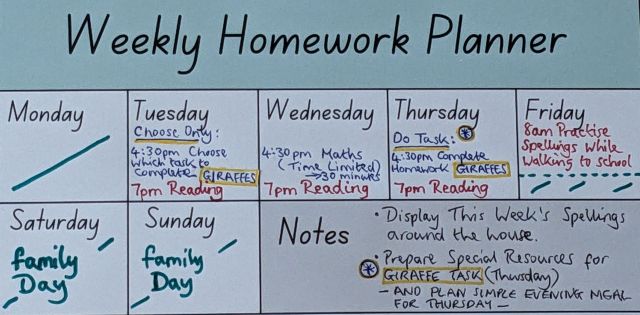
Therefore, as much as possible we tried to do all homework tasks between Monday and Friday so that our son could enjoy his weekends. In fact, Mondays and Fridays were not the best days for us either. Our son was often quite tired on Monday after school because he often did not sleep well on a Sunday night due to thinking about returning to school. By the time Friday evening came around, he was more than ready to stop.
Our best approach was to try and schedule most of our son’s homework on Tuesdays, Wednesdays and Thursdays. This was the period during the week when our son accepted he was in the full flow of the school week and was more willing to focus on homework tasks.
This is where your full and detailed knowledge of the school’s expectations for homework can be extremely useful (see Idea 1 in Part 2 of this series for a full discussion of understanding the school’s homework expectations).
If you know when homework is set by the teacher each week and you know when the deadline is for each homework task, you can identify the window of opportunity available to you to complete the homework before the deadline. From that window of time you can select the most appropriate day for you to do that piece of homework with your child.
It’s worth experimenting with different schedules until you hit upon the one that works best for your family.
Taking Account of the Parents’ Needs when Selecting the Time for Homework
In part 1 of this series, I emphasised that both you and your child are interacting at the homework table, so both of you can affect how calmly the session goes.
When selecting an appropriate time for homework, it is important to not only consider your child’s needs but also work out what is best for you as the parent.
Some days will be better than others for you. Certain times of each day will be more appropriate than others. It is important that you do not try to do homework at a time when you as the parent feel overly stressed, short of time, overwhelmed or distracted.
Here are some examples of things you might consider:
- Are there certain days each week that you know are particularly long and difficult for you at work? If so, it is probably best to try to avoid selecting those days for homework, if possible.
- It is best not to plan a homework session just before you are due to start cooking a complicated and lengthy recipe for the evening meal. I know how much stress can begin to well up inside of you when you have a certain meal planned for dinner and homework is taking longer than expected. The urgency to finish the homework can cause unbearable tension and unnecessary upsets. I would recommend purposefully planning some very simple evening meals on the nights when you are due to do homework – especially when you are first settling into a new homework routine. This will take the pressure off of you.
- Avoid trying to complete homework on evenings when you have visitors at a certain time or have an appointment that must not be missed. Any such immovable deadlines or possible interruptions are likely to cause tension during homework sessions.
- If you have more than one child you will need to consider all of the children’s homework commitments. You will need to decide what approach makes you feel the most calm. Is it best to have them all doing homework together, or is it best to concentrate on one child’s homework at a time? If juggling all of your children’s homework alone is a great cause of tension, maybe select an evening when you know you will have support from another adult. Perhaps seek out your partner’s help at the weekends and approach the homework together, or do homework on an evening when a friend or a grandparent can attend and help you out.
- I know not everybody has alternative options or extra help available to them. The important aim is to try and use any resources or choices you do have to ensure, as much as possible, that you allow plenty of time to complete the homework. When blocking out a period of time, I would recommend allowing the amount of time you think the homework will take, plus a buffer of extra time. The extra buffer time will factor in those possible hiccups that might occur!!
Overall, your aim is to make yourself feel as calm as possible while helping with the homework. Thinking things through in advance, taking account of all the factors that can impact your homework sessions and blocking out the necessary time on a day of the week that is most appropriate for you can really help homework go smoothly for everyone.
Staggering the Homework over various days and times. It does not all have to be done at once
A final thing that is good to remember is that not all homework has to be done at the same time and not all homework has to be completed while sitting at a desk.
Some homework can be done as you walk to school and other tasks can be completed while sitting in bed. Some homework tasks can simply be displayed in the house throughout the week for your child to learn as and when they choose to look at them. Please note these different approaches to homework will be discussed in more detail later in this series under the headings of ideas numbered 8, 9 and 10 (see Part 5 and Part 6 for details).
Homework tasks can therefore be staggered throughout the week rather than trying to do them all in a big block all at once.
Short periods of focused attention from your child are much more likely to remain calm and productive than long drawn-out homework sessions.
Prepare your Home Environment for each Homework Session
Having a suitable location set up within the home to do homework can make all the difference to how a homework session goes.
Not everyone has the space for separate desks for their children. When my son was young he did not have his own desk.
We used our dining table for any homework that required space at a desk. My son also enjoyed sitting on the floor and leaning his work on a lidded toy box if the nature of the homework did not require a formal desk for writing or drawing. We found that a change of location added a bit of novelty and made things more interesting for him.
We use the dining table for eating pretty much every day, therefore, we could only set up a temporary homework station there for each homework session.
Whether you are using a formal desk that can be left permanently set up for homework or need to set up a temporary workstation for each homework session, this is something that I would advise parents to set up in advance of each session.
You do not want your child to have to wait for the space to be made ready before they can start their homework. This could begin to test their patience before you even start!!
Make this a simple task you do in advance. It is much less stressful (and probably saves time and energy!!) if you do this without your child waiting and watching. If your child learns the benefits of working in a clear space, you can then teach them to clean their own space for homework when they get older and more independent.
You can make sure the space is clear and free of clutter. You can check what homework you are planning to complete with your child and make sure you have cleared the space they like to use for that type of task. For example, if it is a writing or drawing task you could clear the dining table, if it is a reading or memorising task (e.g. spellings or times-tables) you might wish to clear another location, such as the top of a toy box, in readiness instead.
You can also gather together all of the necessary equipment you will need for that particular homework and place it in the correct location for the homework to take place.
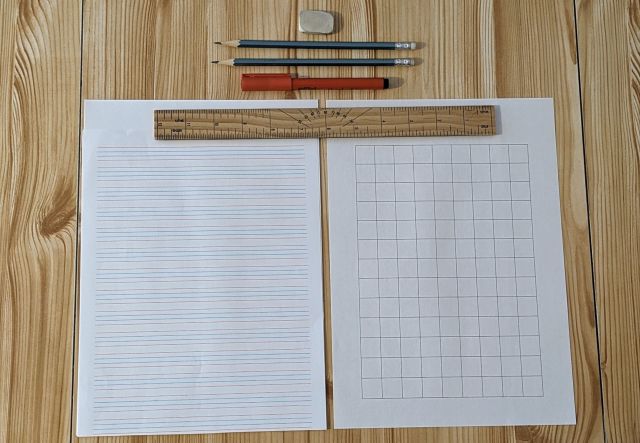
Check that all pens, pencils, paper and other equipment are collected at the homework station in working order and ready for use.
If you have prepared some modified resources in advance to help your child, you can place those at the homework station too (see Idea Number 9 discussed in Part 6 of this series for a full discussion of preparing modified resources).
As well as clearing the actual space where your child will do the homework, I would also recommend taking a look around the whole room in which the homework will be completed.
As far as possible, I would recommend that you remove or put away anything that you know may become a source of distraction, tension or upset during the homework session.
For example, if your child gets upset that they cannot use their devices such as their tablet or handheld games console during their homework, you can put those things away out of sight before you begin. This will help to prevent them from causing a distraction.
If your child tends to grab and fiddle with things when they are nervous or finding it hard to concentrate on their homework, you may want to make sure that any items they tend to grab for or fiddle with are out of sight and out of reach during homework too.
If you would like to read more details about this, please refer back to my previous post which details how minimalism can help you to prepare a room in a way that will help you and your child to focus, concentrate and remain calm.
Click here to read the post on Minimalism. The sections headed “What Minimalism Can Teach Us”, “My Son and Our Parenting”, “Before”, “After” and “The impact on our wellbeing and Mindset” will be of particular interest to you in the context of homework.
In the next part of this series (Part 4) we will be discussing how you can mentally prepare yourself for each homework session and how you can reduce anxiety for your children by separating the process of choosing which task to do from actually completing the task (Click here to read Part 4 now).
Thank you for reading.
Clare
Whilst reading this series, please bear in mind that I am not an expert in education or home learning. What I share here is simply based on my own experiences with my own family (along with some very helpful advice from my dad who was a teacher).
If in doubt, I would always recommend liaising with your own child’s teacher and school or another qualified professional.
Resources
Book
Essentialism, The Disciplined Pursuit of Less by Greg McKeown, 2014 (Ebury, Penguin Randomhouse Group) – Please see Part 1 & Part 2 of this Blog Series for a full explanation of how I found this book helpful when designing a calm approach to homework
Follow Me on Instagram
(You’ll find me @its_calmwithclare)
Click the Instagram link below to visit My Profile page and discover Posts, Reels and Stories about all things calm. I generally post each week on themes relating to the “Featured Post” on this blog*.
Follow Me on Pinterest
(You’ll find me @calmwithclare)
If you would like more inspiration and to explore a variety of resources about children, homework and school you may wish to click the Pinterest link below and take a look at my Saved Pinterest Boards “Calm Words for Kids” and “Back to School“.
I would love for you to join me on Instagram and Pinterest.
*Please visit this blog’s About page to find details of this week’s featured post.

Visit the About page now to design your reading plan for the blog
 Creating Calm with Clare